YAML is everywhere in infrastructure — Kubernetes manifests, GitHub Actions workflows, Docker Compose files, Ansible playbooks. It is readable and compact, right up until indentation becomes ambiguous, a tab sneaks in where a space should be, or you need to feed the data into a tool that only understands JSON.
Converting between the two by hand is mechanical but tedious: YAML's indentation-based nesting becomes JSON's braces and brackets, unquoted YAML strings need quotes, and YAML's more permissive syntax (unquoted booleans, multi-line strings, anchors and references) does not always map cleanly to JSON's stricter rules.
Why You Need Both Formats
You might write a Kubernetes manifest in YAML because it is easier to read and version-control, but need the JSON equivalent to feed into a script, an API call, or a jq pipeline that expects JSON input. Or you are debugging why a CI pipeline's YAML config is not parsing the way you expect, and seeing the JSON structure underneath makes the actual nesting unambiguous in a way that whitespace-sensitive YAML sometimes is not.
Convert Between Formats Instantly
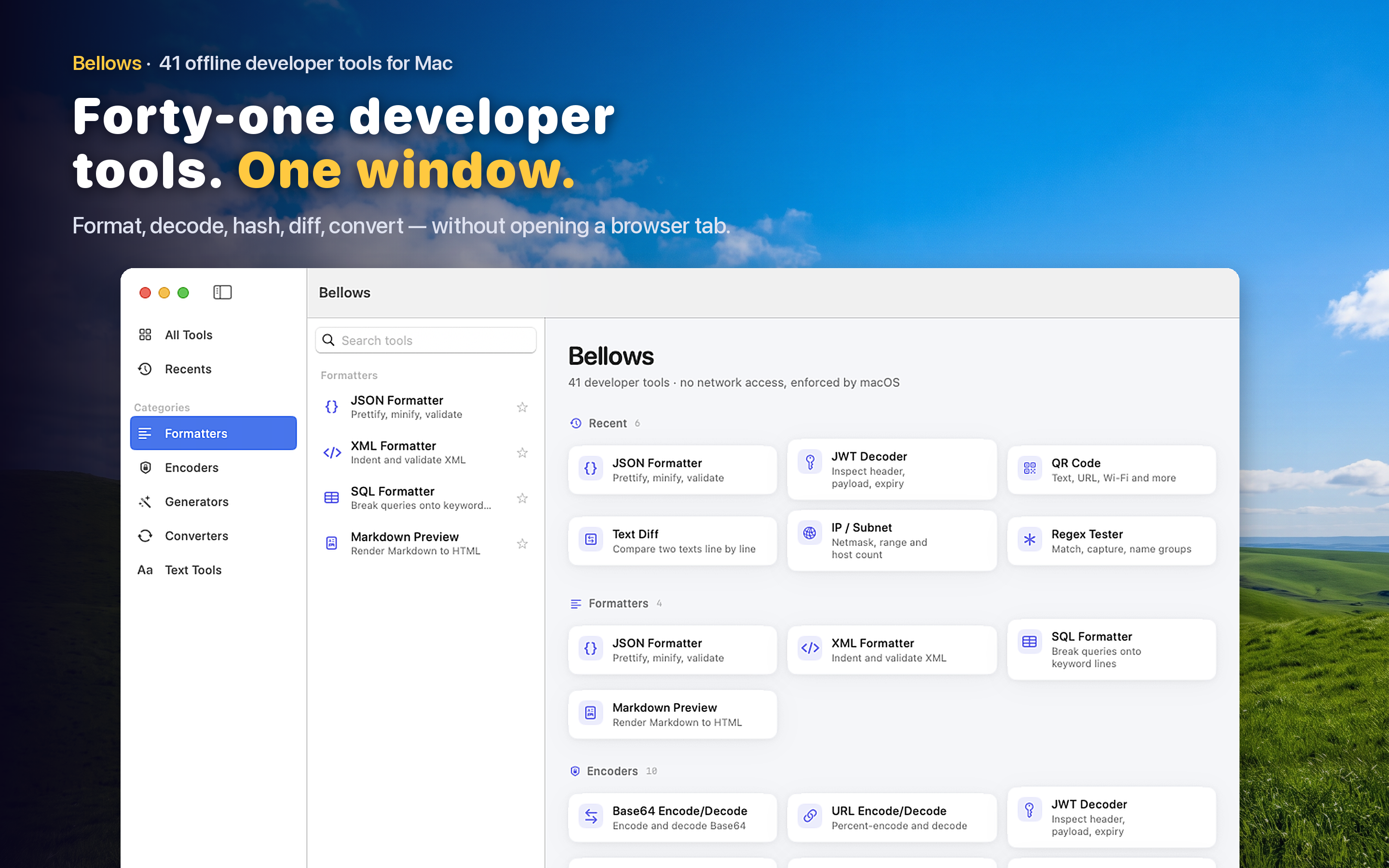
Bellows includes a YAML to JSON converter among its 41 developer tools. Paste YAML and get the equivalent JSON structure immediately, with proper nesting and types preserved — no manual reformatting, no guessing at indentation levels.
Debugging Kubernetes and CI Configs
When a manifest behaves unexpectedly, seeing the underlying JSON structure removes any ambiguity about how the YAML actually nested — useful when a misplaced indent has silently changed which key belongs to which parent object.
Feeding Config Into Scripts
Plenty of scripting and automation tools work more naturally with JSON than YAML. Converting a config file once and passing the JSON output downstream is often simpler than teaching every script in your pipeline to parse YAML directly.