·8 min read

Mac Volume Too Low? How to Boost Sound Beyond 100%

Your Mac is at full volume and it's still too quiet. Here's why that happens and how to amplify audio up to 200% without external speakers.

Your Mac volume is at 100%. The slider is all the way to the right. And it's still not loud enough. The podcast is too quiet. The video call participant sounds like they're whispering. The YouTube video was recorded too low. You've maxed out — and it's not enough.

This is one of the most common audio complaints on Mac, especially with the built-in speakers on MacBook Air and older MacBook Pro models. The speakers are physically small, and some content is simply recorded at a lower level than others.

Here's why it happens and how to actually fix it — including how to boost your Mac's volume beyond the 100% limit.

Why your Mac sounds too quiet at full volume

There are several reasons your Mac might not be loud enough even at maximum volume:

1. The content itself is quiet

Not all audio is mastered at the same level. A professionally produced podcast might peak at -3 dB, while a casual YouTube video or a recorded Zoom call might peak at -20 dB. The difference is massive. When your system volume is at 100%, quiet content stays quiet — macOS can only amplify up to the original signal level.

2. MacBook speakers have physical limits

The built-in speakers in a MacBook Air or a 13" MacBook Pro are small. They're designed for portability, not volume. Apple's larger MacBook Pro models (14" and 16") have significantly better speakers, but even they have a ceiling. If you're used to external speakers or headphones, the built-in speakers will feel weak.

3. Bluetooth volume is capped

Some Bluetooth headphones and speakers have their own volume ceiling that's separate from macOS. Even if macOS shows 100%, the Bluetooth device might not be at its maximum. This is especially common with AirPods, where the EU volume limiter or the headphone safety feature in Settings → Sound → Headphone Safety can cap the output.

4. Individual app volumes are low

Some apps have their own internal volume control that's separate from the system volume. If Spotify's in-app volume is at 50% and the system volume is at 100%, you're effectively listening at 50%. Zoom often defaults to a conservative volume level for calls.

Built-in fixes to try first

Check headphone safety limits

Go to System Settings → Sound → Headphone Safety. If "Reduce Loud Audio" is enabled, macOS is actively limiting your volume to protect your hearing. You can disable this or raise the threshold. This only affects headphones — it doesn't touch speaker output.

Check Bluetooth device volume

Some Bluetooth devices have independent volume controls. For AirPods, make sure the volume on both the Mac and the AirPods is maxed. For third-party Bluetooth speakers, check if the speaker has its own volume button or app.

Check in-app volume

Open the app that's too quiet and look for its own volume slider. Spotify has one in the player bar. VLC has one in the playback controls. YouTube has one on the video player. Make sure these are at 100% before concluding that your Mac is the problem.

Reset Core Audio

Sometimes the macOS audio system gets into a bad state after sleep/wake cycles or device changes. Open Terminal and run:

sudo killall coreaudiod

This restarts the audio daemon. Your audio will cut out for a second and come back, sometimes at a more normal level.

How to boost volume beyond 100%

If you've checked everything above and your Mac is still too quiet, you need volume amplification — the ability to push audio above the 100% ceiling that macOS imposes.

Volume boosting works by intercepting the audio signal before it reaches your speakers and multiplying its amplitude. At 150%, every audio sample is 1.5x louder than the original. At 200%, it's doubled. This can introduce slight distortion at extreme levels with certain content, but for quiet audio it's the only way to make it actually audible.

SoundDial: per-app volume boost up to 200%

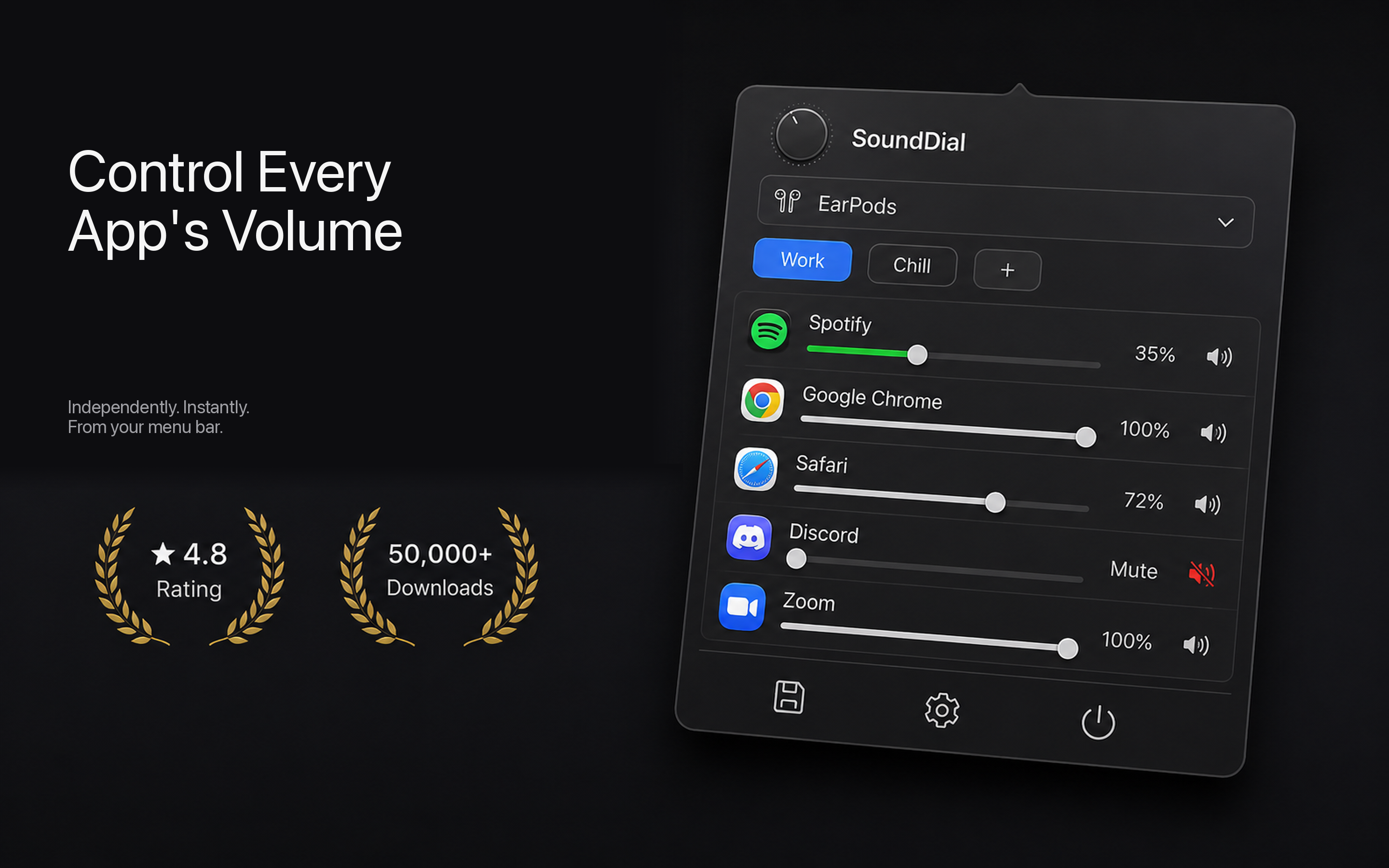
SoundDial gives every app on your Mac an independent volume slider that goes from 0% to 200%. If a specific app is too quiet — a podcast player, a browser tab, a video call — you can boost just that app beyond 100% without touching anything else.

SoundDial volume boost — per-app volume control with 200% amplification on macOS

This is particularly useful for:

  • Quiet podcast apps — some players max out too low, especially with podcasts recorded in suboptimal conditions
  • Video calls with quiet participants — boost Zoom or Teams when someone's mic is low, without making your music louder
  • Browser tabs — YouTube videos, web apps, and embedded media often play at lower volumes than dedicated media apps
  • Old recordings — archival audio, vintage music, and older video content is often mastered at lower levels

The key advantage over system-wide volume boosters is that SoundDial boosts per app. You can boost the quiet app to 180% while keeping everything else at normal levels. A system-wide booster would amplify everything equally, making your already-loud apps painfully loud while the quiet one gets slightly less quiet.

When external solutions are better

Volume boosting has limits. If you're trying to fill a room with sound from a MacBook Air's built-in speakers, no software can overcome the physical size of those speaker drivers. In that case:

  • Wired headphones — bypass speaker limitations entirely, and most headphones can get louder than built-in speakers
  • External speakers — even a cheap pair of USB or Bluetooth speakers will outperform built-in MacBook speakers for raw volume
  • USB audio interface — for professional use, a dedicated audio interface provides a clean, powerful signal to studio monitors or headphones

But for the everyday case — a browser tab that's too quiet, a call where someone's mumbling, a podcast that was recorded in a closet — software volume boosting with SoundDial is the fastest fix. Click the menu bar icon, drag the slider past 100%, done.

One-time purchase on the Mac App Store. No subscription. macOS 14.2+.

下一篇文章

SoundSource Alternative: Lighter, Cheaper Per-App Volume Control for Mac

SoundSource is powerful but expensive and complex. If you just need per-app volume control without the audio engineering toolkit, here's what to use instead.

SoundDial

Per-app volume control for macOS. €14.99 one-time purchase.

取得SoundDial