A single countdown covers most days, but not all of them. Hosting a dinner with three dishes on different clocks, running a workshop with timed segments, or juggling a laundry cycle alongside a work sprint — these all call for more than one timer ticking down independently, each with its own alert when it finishes.
The trouble is that most timer tools, built and tested around the single-countdown case, either don't support a second timer at all or bury additional ones in a list you have to open a window to check.
How single-timer tools break under multiple countdowns
Starting a second timer in the Clock app silently replaces the first — there's no warning, and no way to run both. Siri behaves the same way, treating each new request as the one active timer rather than adding to a set. Apps that do support multiple timers often stack them as rows in a list inside a window, which means checking on any one of them requires opening that window and scanning for the right entry.
The fix: Tickpull
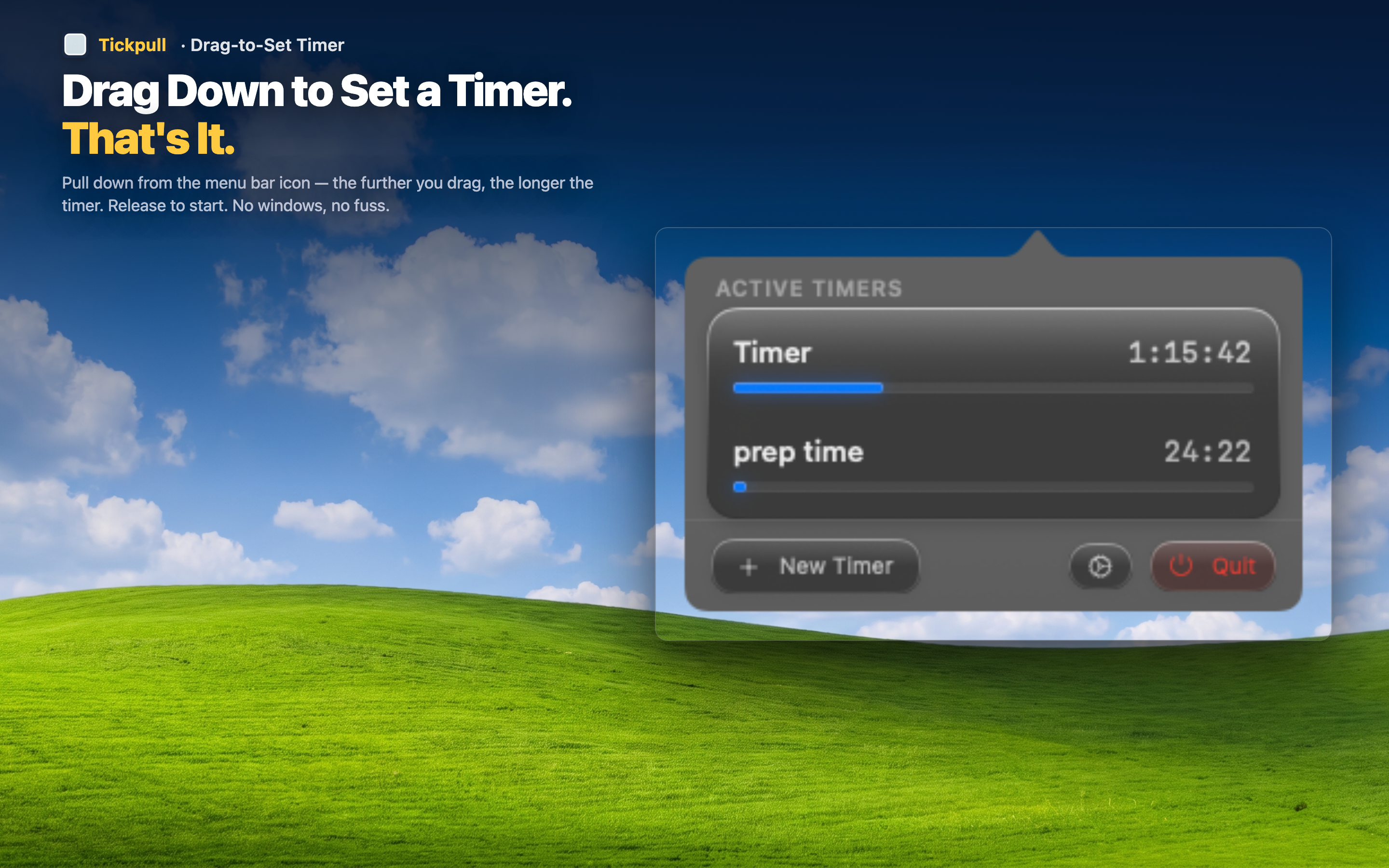
Tickpull treats parallel timers as a core capability rather than an edge case. Each timer you start gets its own ring in the menu bar, filling independently, so you can track several countdowns at a glance without opening anything.
Hosting and cooking multiple dishes
Appetizer at 10 minutes, main course at 25, dessert timer set later once the oven frees up. Three drags, three rings, three independent alerts as each one finishes.
Running a workshop with timed segments
A segment timer alongside an overall session timer lets you track both how long the current activity has been running and how much time remains in the whole workshop, without doing mental subtraction.
Errands and chores around the house
Laundry cycle, dishwasher, and a reminder to check on something in the oven can all run at once. Each ring alerts independently, so nothing gets forgotten just because another timer finished first.