Vous débranchez vos écouteurs et souhaitez que le son soit acheminé vers vos haut-parleurs. Ou vous connectez des AirPods et macOS sélectionne le mauvais appareil. Ou vous entrez dans une salle de réunion et devez passer au haut-parleur de la conférence. À chaque fois, c'est : Paramètres système → Son → Sortie → défilement → clic. Trop de clics pour quelque chose qui devrait en prendre un.
Voici toutes les façons de changer de sortie audio plus rapidement sur Mac — des raccourcis intégrés aux outils de la barre de menus qui éliminent complètement le clic.
Méthode 1 : Option-cliquez sur l'icône du volume
Il s’agit de la méthode intégrée la plus rapide et la plupart des gens ne la connaissent pas.
Tenir Options (⌥) et cliquez sur l'icône volume/son dans votre barre de menu. Au lieu du curseur de volume normal, vous obtenez une liste de tous les périphériques de sortie disponibles. Cliquez sur celui que vous voulez. Fait.
Si vous ne voyez pas l'icône du son dans votre barre de menus, activez-la : Paramètres système → Centre de contrôle → Son → sélectionnez "Toujours afficher dans la barre de menus".
Limite : Cela affiche uniquement les périphériques de sortie – vous ne pouvez pas régler le volume par application ni voir ce qui est en cours de lecture à partir de ce menu.
Méthode 2 : Centre de contrôle
Cliquez sur l'icône Control Center (l'icône à deux bascules) dans la barre de menu → cliquez sur la section Son → cliquez sur le nom de l'appareil actuel pour voir toutes les sorties disponibles.
Limite : C'est trois clics au lieu d'un. Légèrement plus lent que Option-clic sur l'icône de volume.
Méthode 3 : raccourci des paramètres système
Vous pouvez épingler Sound dans la barre latérale supérieure des paramètres système, mais cela nécessite toujours d'accéder à l'onglet Sortie et de sélectionner un périphérique. Pas vite.
Méthode 4 : raccourci clavier (avec configuration)
macOS ne dispose pas de raccourci clavier intégré pour changer de périphérique audio. Cependant, vous pouvez en créer un à l'aide d'Automator ou de raccourcis :
- Ouvrir l'application Raccourcis
- Créez un nouveau raccourci qui exécute un script shell :
SwitchAudioSource -s "Nom du périphérique"(nécessite leswitchaudio-osxoutil de ligne de commande de Homebrew) - Attribuer un raccourci clavier au raccourci
Cela fonctionne mais nécessite Homebrew, un outil de ligne de commande et une configuration manuelle par appareil. Pas pratique pour la plupart des utilisateurs.
Méthode 5 : sélecteur de périphérique intégré à SoundDial
SoundDial inclut un sélecteur de périphérique de sortie directement dans la fenêtre contextuelle de sa barre de menus, à côté de vos curseurs de volume par application. Un clic pour ouvrir SoundDial, un clic pour changer d'appareil. Pas besoin de fouiller dans les paramètres système.
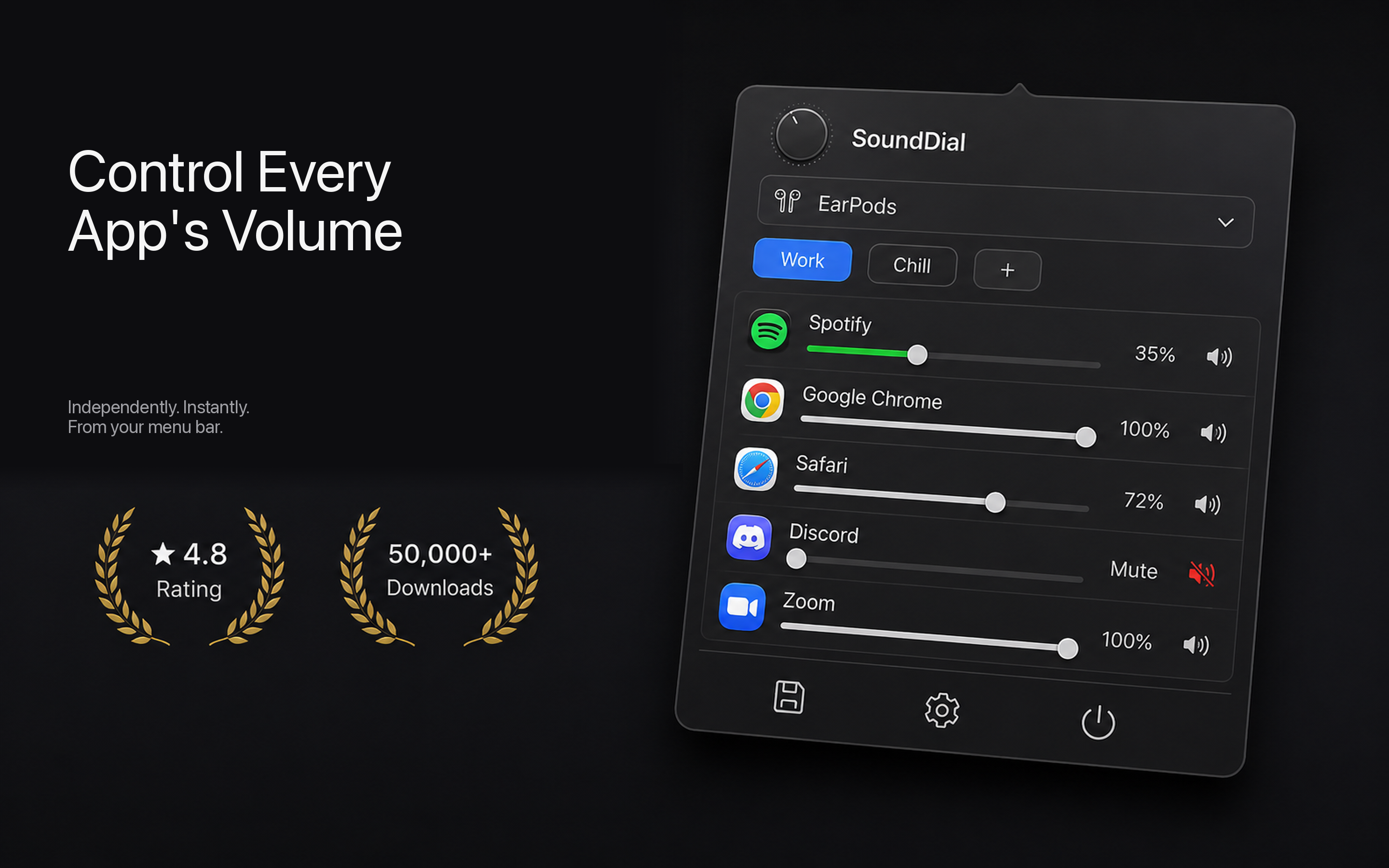
L'avantage de changer d'appareil à l'intérieur de SoundDial : vous pouvez changer votre sortie et ajustez les volumes par application dans le même panneau. Passez aux AirPods et réduisez immédiatement Spotify tout en augmentant votre appel, le tout sans quitter le popover.
Combiné avec les SoundDial mémoire de volume fonctionnalité, chaque périphérique de sortie peut mémoriser ses propres niveaux de volume par application. Passez aux haut-parleurs et la balance du volume de vos « haut-parleurs » s’applique. Passez aux écouteurs et votre solde « écouteurs » s'applique. Pas de réajustement manuel.
Obtenez SoundDial sur l'App Store Mac — 14,99 € d'achat unique, sans abonnement, macOS 14.2+.