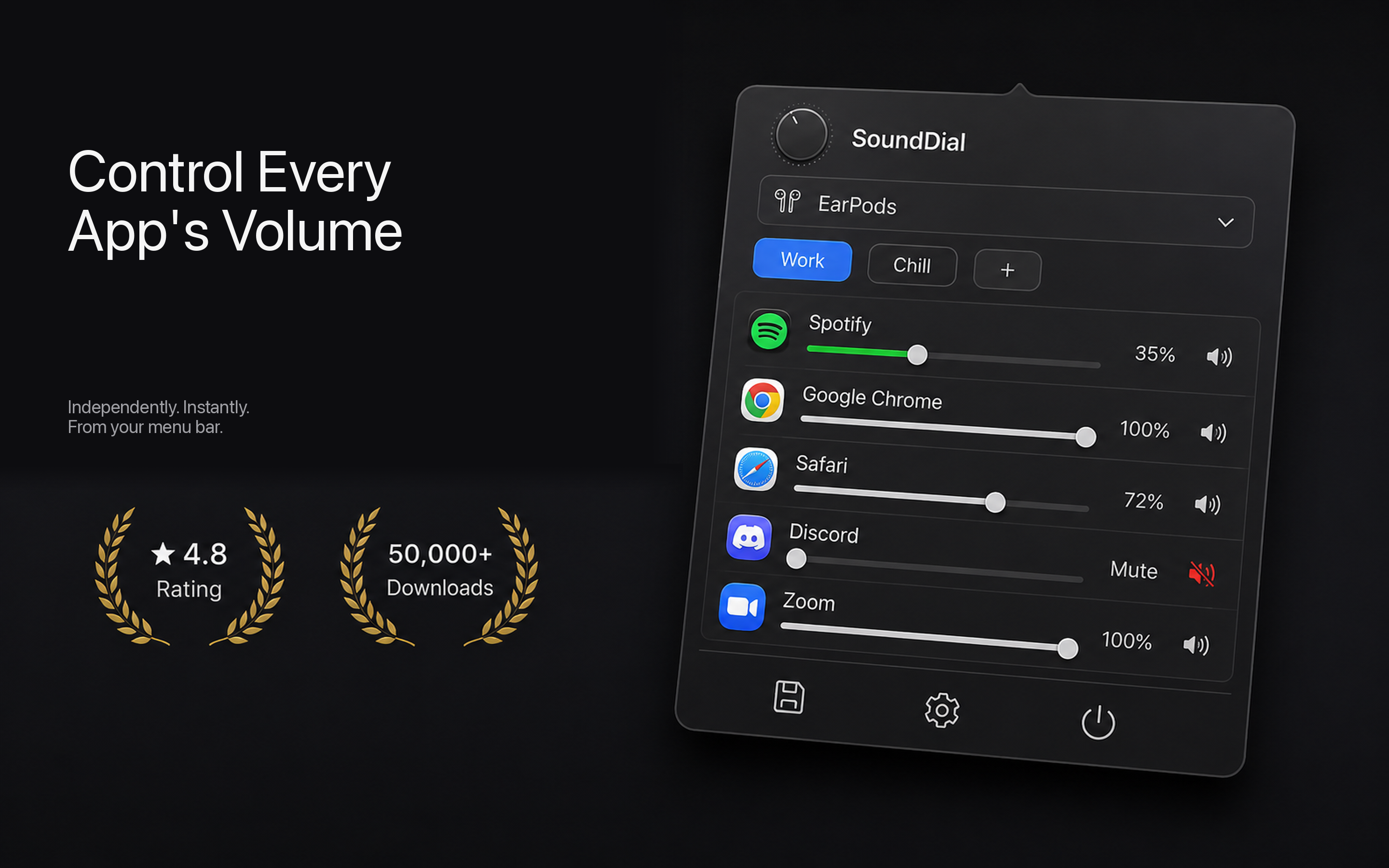
macOS doesn't have a built-in volume mixer. If you want to control the volume of individual apps — turn down Spotify without affecting Zoom, mute Slack without muting everything — you need a third-party app.
There are several options. This guide compares the most notable ones based on features, pricing, compatibility, and actual usability. No affiliate links, no sponsored picks.
What you should look for
Before comparing apps, here's what matters in a Mac volume mixer:
- Per-app volume sliders — independent control for every running app
- Volume range — can you go below 100% AND above 100% (boost)?
- Per-app mute — silence one app without touching its volume position
- Profiles — save and switch between volume configurations
- Auto-ducking — automatically lower music during calls
- Menu bar integration — quick access without switching apps
- macOS compatibility — works on the latest macOS version
- Pricing model — one-time purchase vs. subscription
The options
SoundDial
SoundDial is a native macOS menu bar app focused on doing one thing well: per-app volume control.
- Per-app volume: Yes, 0% to 200%
- Per-app mute: Yes, one-click
- Volume boost: Yes, up to 200%
- Profiles: Yes, with custom names and icons
- Auto-ducking: Yes, with configurable duck level
- Keyboard shortcuts: Yes (toggle mixer, mute all)
- Output device switching: Yes, from the same panel
- Volume memory: Yes, remembers each app's volume between restarts
- Price: €14.99 one-time purchase (no subscription) — less than half the price of SoundSource
- Requires: macOS 14.2+
- Available on: Mac App Store (Apple-reviewed, sandboxed, no system drivers)
SoundDial uses Apple's modern Core Audio Tap API for clean per-process audio control. It's lightweight, runs entirely in the menu bar, and doesn't require complex setup. At €14.99, it's significantly cheaper than SoundSource ($39) while including features SoundSource lacks — volume profiles and auto-ducking. And because it's on the Mac App Store, it's Apple-reviewed, sandboxed, and installs cleanly without downloading DMGs or installing system audio drivers.
SoundSource (Rogue Amoeba)
SoundSource is one of the oldest and most established Mac audio utilities. It's powerful and feature-rich, targeting power users and audio professionals.
- Per-app volume: Yes
- Per-app mute: Yes
- Volume boost: Yes
- Per-app EQ: Yes (built-in and AU plugin support)
- Per-app output routing: Yes (send different apps to different speakers)
- Profiles: No built-in profile system
- Auto-ducking: No
- Price: $39 USD (one-time, major upgrades may require additional purchase)
- Requires: macOS 12+ (installs a system audio driver)
SoundSource is the most powerful option if you need per-app EQ and audio effect chains. It installs a system-level audio driver (ACE) to intercept audio, which makes it very capable but also more invasive. The $39 price point is higher than most alternatives, and there's no auto-ducking or profile system.
Background Music (Free, Open Source)
Background Music is a free, open-source app that provides basic per-app volume control. It's a popular choice because it's free.
- Per-app volume: Yes
- Per-app mute: Yes
- Volume boost: No (0-100% only)
- Auto-pause music: Yes (pauses music when another app plays audio)
- Profiles: No
- Auto-ducking: No (auto-pause is different from auto-duck)
- Price: Free
- Requires: macOS 10.13+ (installs a virtual audio device)
Background Music is a solid free option for basic per-app volume. However, it hasn't been consistently updated for newer macOS versions. Users report issues on macOS Sequoia and Tahoe — audio glitches, the virtual audio device failing to install, or the app not detecting some applications. It also can't boost volume past 100%, has no profiles, and no auto-ducking.
eqMac
eqMac is primarily an equalizer app that also includes some volume mixing capabilities.
- Per-app volume: Limited (focused on EQ, not mixing)
- System-wide EQ: Yes, with multiple band options
- Volume boost: Yes
- Profiles: EQ presets (not volume profiles)
- Auto-ducking: No
- Price: Free tier + Pro subscription
- Requires: macOS 10.14+
eqMac is the better choice if your primary need is system-wide equalization (bass boost, treble adjustment, etc.) rather than per-app volume control. Its volume mixing capabilities are secondary to its EQ features.
Quick comparison table
| Feature | SoundDial | SoundSource | Background Music |
|---|---|---|---|
| Per-app volume | Yes | Yes | Yes |
| Volume boost (200%) | Yes | Yes | No |
| Volume profiles | Yes | No | No |
| Auto-ducking | Yes | No | No |
| Per-app EQ | No | Yes | No |
| Per-app output routing | No | Yes | No |
| Keyboard shortcuts | Yes | Yes | No |
| System driver required | No | Yes | Yes |
| Price | One-time | $39 | Free |
Which one should you pick?
- If you want per-app volume control, profiles, and auto-ducking: SoundDial — the most complete volume mixer for the price, with features (profiles, auto-ducking) that even more expensive alternatives lack.
- If you need per-app EQ and audio routing: SoundSource — the most powerful option, aimed at audio professionals who need effect chains and per-app output routing.
- If you want something free and basic: Background Music — decent for simple per-app volume, but can have compatibility issues on newer macOS versions and lacks boost/profiles/ducking.