You're gaming on your Mac. An explosion goes off in-game. Your Discord teammates are talking, but you can't hear them over the gunfire. You turn down the volume — now Discord is quieter too. You turn it back up — the explosions are deafening again.
On Windows, you'd open the volume mixer, turn the game down to 40%, and leave Discord at 100%. On Mac, you can't. macOS gives you one volume slider for everything, so game audio and voice chat are permanently linked.
This guide shows you how to get independent volume control for your game and Discord (or any voice chat) on Mac.
Why this is a Mac-specific problem
Windows has had a built-in volume mixer since 2006 that lets you control every app's volume independently. macOS has never added this feature. Every app's audio gets mixed into a single stream, and the only control you have is one master slider that affects everything equally.
This means:
- If your game is too loud, turning it down also turns down Discord
- If Discord is too quiet, turning it up also turns up the game
- You can't find a balance because both apps are locked to the same volume
The workarounds that don't really work
Use in-game volume settings
Most games have an audio settings menu where you can lower the master volume, music, sound effects, and voice chat independently. This helps, but you're changing settings inside the game — meaning you have to pause gameplay, navigate menus, and adjust every time conditions change. And if you switch games, you start over.
Use Discord's volume controls
Discord lets you adjust the output volume in Settings → Voice & Video, and you can adjust individual users' volumes by right-clicking their name. But this controls Discord's internal mix, not its volume relative to other apps. If the game is too loud, making Discord louder internally doesn't help because the system volume affects both equally.
Use different output devices
Some people try routing game audio to speakers and Discord to headphones (or vice versa). macOS doesn't make this easy — you'd need a virtual audio device and manual per-app routing. And wearing headphones with speakers playing simultaneously is awkward at best.
The actual solution: per-app volume control
What you need is the ability to set your game's volume independently from Discord's volume. This is exactly what a per-app volume mixer does.
SoundDial sits in your menu bar and gives every app its own volume slider. You can set your game to 35% and Discord to 100% — or whatever ratio works for you. Change one and the other stays put.
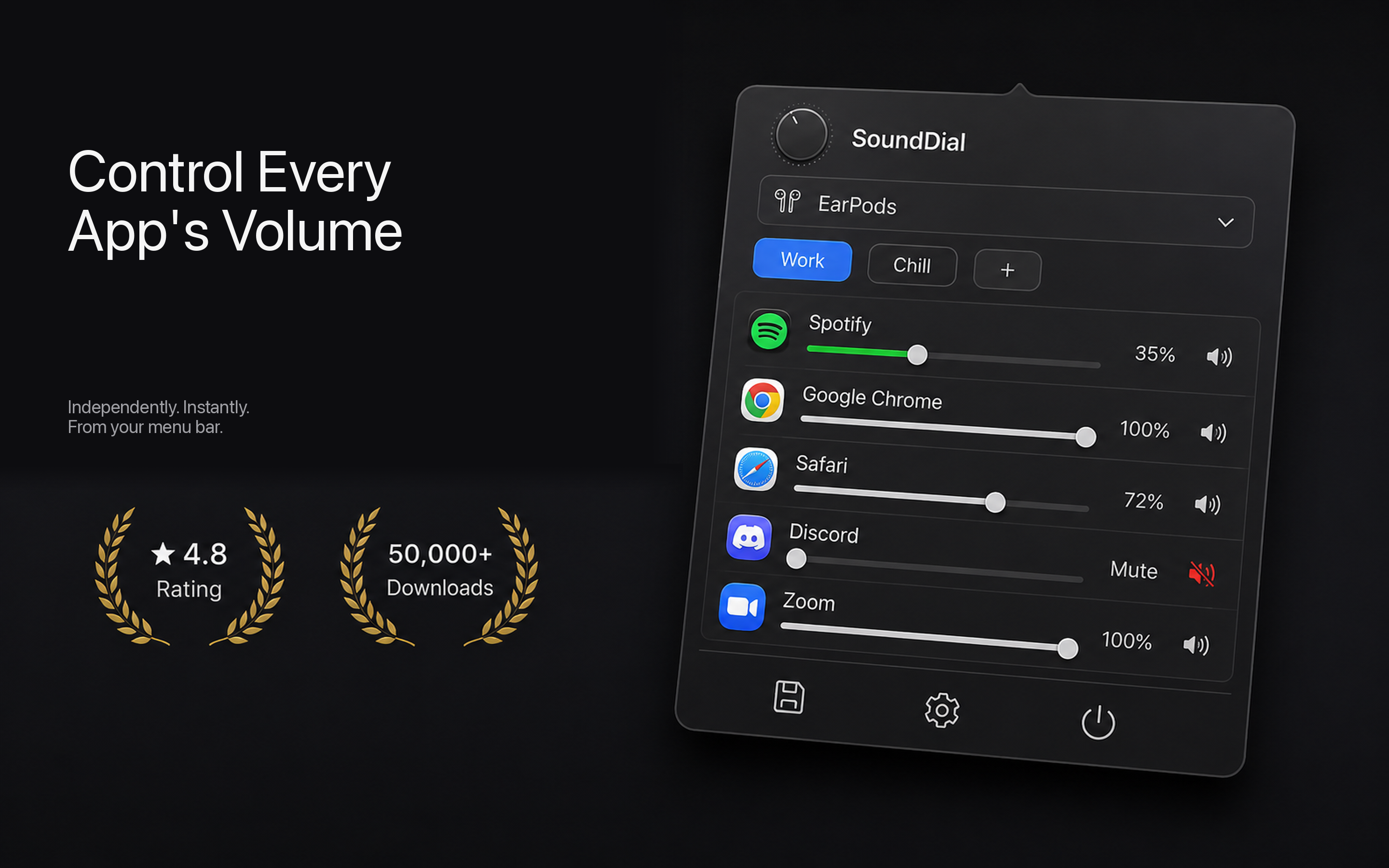
Typical gaming setup
- Game — 30-50% (loud enough for immersion, not overwhelming)
- Discord / voice chat — 90-100% (always clearly audible over game audio)
- Spotify / music — 15-25% (subtle background, doesn't interfere)
- Browser — muted (no surprise auto-play videos)
- Slack / notifications — muted (focus time)
Save it as a profile
SoundDial's volume profiles let you save this configuration and apply it with one click. Create a "Gaming" profile with your preferred game/Discord balance, a "Work" profile for music and calls, and switch between them instantly. No re-adjusting sliders every time you sit down to play.
Volume boost for quiet voice chat
Sometimes the problem isn't that the game is too loud — it's that Discord is too quiet. Some teammates have bad mics, or Discord's output is lower than other apps. SoundDial lets you boost any app's volume up to 200%, so you can amplify Discord beyond its normal maximum without touching the game volume.
Works with any game and any voice chat
SoundDial works with every app that produces audio on macOS. It doesn't matter if you're playing through Steam, the App Store, Epic Games, or a browser game. It doesn't matter if you're using Discord, TeamSpeak, Mumble, or FaceTime. If it makes sound, SoundDial can control it.
Get SoundDial on the Mac App Store — €14.99 one-time purchase, no subscription, macOS 14.2+.