macOS gives you a volume slider and a mute button. That's the extent of Apple's built-in audio control. But your Mac actually has far more audio capabilities than the surface suggests — hidden keyboard shortcuts, per-app volume tools, output device management, and automation features that most users never discover.
This is the complete guide to controlling audio on your Mac. From basics to power-user features, everything in one place.
Part 1: Built-in volume controls
The volume keys
The volume up (F12), volume down (F11), and mute (F10) keys adjust system volume in 16 steps. Each step is roughly 6.25% of the total range. The current volume is shown as an overlay on screen.
Fine-grained volume: Option + Shift
Hold Option + Shift and press volume up/down. Each press adjusts by one quarter of a normal step — giving you 64 volume levels instead of 16. Essential for finding the perfect headphone volume when the normal steps are too coarse.
Silent volume adjustment: Shift
Hold Shift and press volume up/down. The volume changes without the audible feedback "pop." Use this when adjusting volume during a call or presentation.
Menu bar volume slider
If the Sound icon is in your menu bar (enable it in System Settings → Control Center → Sound → Always Show in Menu Bar), clicking it shows a volume slider. This is a continuous slider, not stepped like the keyboard keys, so you can set any precise level.
Control Center
Click the Control Center icon (two-toggle icon) in the menu bar → click the Sound section for a volume slider and quick access to output device selection.
Part 2: Output device management
Switching output devices
The fastest built-in method: hold Option and click the Sound icon in the menu bar. You'll see a list of all available output and input devices. Click one to switch instantly.
Alternatively: System Settings → Sound → Output. Select your preferred device from the list.
Bluetooth device management
macOS remembers the volume level for each output device separately. When you switch from speakers (at 70%) to AirPods (at 40%), the volume adjusts to what it was last time you used that device. This can feel like the volume is "changing by itself" if you're not expecting it.
Aggregate and multi-output devices
For advanced setups, open Audio MIDI Setup (Applications → Utilities) to create aggregate devices (combine multiple inputs) or multi-output devices (send audio to multiple outputs simultaneously). These are primarily useful for professional audio setups, not everyday use.
Part 3: Alert and notification volume
System alert volume
macOS has a separate alert volume slider: System Settings → Sound → Alert volume. This controls the volume of system sounds (Funk, Tink, Bottle, etc.) independently from the main volume. However, it only affects macOS system alerts — not notification sounds from third-party apps like Slack, Discord, or Teams.
Notification sound management
Go to System Settings → Notifications. For each app, you can toggle "Play sound for notifications" on or off. This is binary — you can't make an app's notifications quieter, only fully on or fully off.
Focus modes
Focus modes (System Settings → Focus) suppress notifications from selected apps. They can silence notification sounds, but they don't affect media volume. Your music keeps playing at full volume even in Do Not Disturb.
Part 4: Headphone-specific controls
Headphone Safety
System Settings → Sound → Headphone Safety. "Reduce Loud Audio" limits headphone volume based on cumulative exposure. You can disable it or adjust the threshold. Only affects headphone output, not speakers.
Spatial Audio
For supported headphones (AirPods Pro, AirPods Max, some Beats), macOS supports Spatial Audio with head tracking. Enable it in Control Center → Sound → Spatial Audio. This affects the perceived positioning of sound but not volume.
Audio balance
System Settings → Accessibility → Audio → Balance. A left-right slider that adjusts the stereo balance. Make sure it's centered if one side sounds quieter than the other.
Part 5: What macOS can't do (and how to fix it)
Per-app volume control
macOS has one volume slider for all apps. There's no built-in way to set Spotify to 30% and Zoom to 100%. This is the single most requested audio feature in macOS, and Apple has never added it.
Volume boost beyond 100%
macOS's volume maxes out at 100%. If content is too quiet even at max volume, there's no built-in way to amplify further.
Volume profiles
There's no way to save a volume configuration (Spotify at 30%, Zoom at 100%, Slack muted) and switch between presets.
Auto-ducking
macOS doesn't automatically lower background audio when you join a call.
Volume memory per app
macOS doesn't remember per-app volume levels because per-app volume doesn't exist.
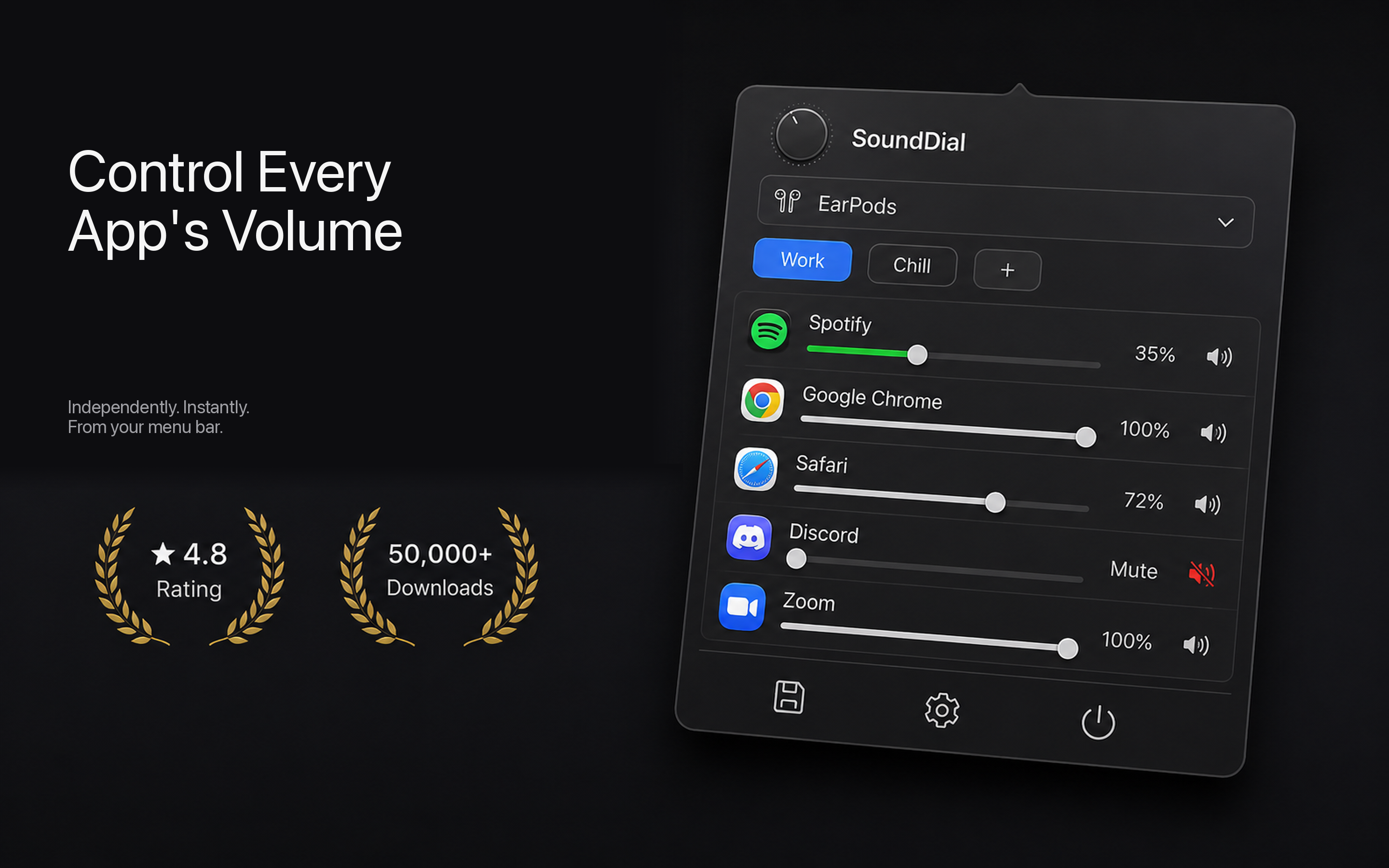
All five of these are available with SoundDial — a native macOS menu bar app that adds the volume mixer Apple never built.
Part 6: Per-app volume with SoundDial
SoundDial fills every gap listed above:
- Per-app volume: Every app gets its own slider, 0% to 200%
- Per-app mute: One click to silence any app
- Volume boost: Amplify quiet apps beyond 100%
- Volume profiles: Save configurations and switch with one click
- Auto-ducking: Background audio lowers during calls, restores after
- Volume memory: Each app's volume is remembered between restarts
- Output device switching: Change speakers/headphones from the same panel
- Keyboard shortcuts: ⌃⌥S to toggle the mixer, ⌃⌥M to mute all
It uses Apple's modern Core Audio Tap API — no system drivers, no virtual audio devices, no kernel extensions. Available on the Mac App Store for €14.99 (one-time purchase, no subscription), Apple-reviewed and sandboxed. macOS 14.2+.