Right-click the speaker icon on any Windows PC and you'll find the Volume Mixer — a panel that shows every application currently making sound, each with its own independent volume slider. You can turn Spotify down to 20% while keeping your Zoom call at 100%. You can mute Chrome without touching anything else. It's been there since Windows Vista in 2006.
Now do the same thing on a Mac. Click the sound icon in the menu bar. You get one slider. That's it. One slider that controls everything at once. Every app, every notification, every system sound — all locked together.
This isn't a niche complaint. It's the single most requested audio feature in macOS, and Apple has ignored it for twenty years.
What a volume mixer actually does
A volume mixer gives you independent volume control for every application on your computer. Instead of one master slider, you get one slider per app. Each slider only affects that specific app's audio output.
Here's what that looks like in practice:
- Spotify at 25% — background music at a comfortable level
- Zoom at 100% — hear every word of the meeting
- Slack muted — no notification dings during focus time
- Safari at 60% — YouTube video at moderate volume
- System Sounds at 10% — subtle feedback without startling you
All of these running simultaneously, each at their own volume. Change one and nothing else moves. That's what a volume mixer does, and that's what macOS doesn't have.
Why Apple hasn't built one
It's not a technical limitation. macOS's audio framework — Core Audio — fully supports per-process audio routing and volume control at the API level. Apple uses these capabilities internally. They just haven't exposed them to users.
The likely reason is Apple's design philosophy: fewer options, simpler interface. One slider is cleaner than twelve. And for someone who only ever does one thing at a time — listens to music OR takes a call OR watches a video — one slider is fine.
But that's not how people use computers in 2026. Remote work means you're on a call with music playing and Slack pinging and a browser tab auto-playing a video, all at the same time. The "one slider for everything" model breaks down completely when you have five audio sources competing for your ears.
The macOS workarounds (and why they fall short)
Use each app's built-in volume control
Spotify has a volume slider. VLC has one. QuickTime has one. But this means switching to each app individually, finding its volume control, adjusting it, and switching back. It's scattered across a dozen different places, and most apps — Slack, Mail, Safari, Chrome — don't even have one.
Use "Do Not Disturb" to silence notifications
Focus modes can suppress notification sounds, but they're binary — everything or nothing. You can't say "keep Slack sounds but make them quieter." And Focus modes don't touch media or call volume at all.
Use Audio MIDI Setup
This built-in utility manages audio devices and sample rates. It has nothing to do with per-app volume. It's a device configuration tool, not a mixer.
Create multi-output devices
You can combine audio outputs into an aggregate device, but this sends the same audio to multiple outputs — it doesn't give you per-app control. It's useful if you want sound on both speakers and headphones simultaneously, but that's a completely different problem.
None of these workarounds solve the fundamental issue: macOS has no built-in way to say "make this app quieter without affecting anything else."
What to look for in a Mac volume mixer
If Apple won't build it, third-party apps will. But not all volume mixers are created equal. Here's what separates a good one from a mediocre one:
Real-time app detection
The mixer should automatically detect every app that's currently producing audio. You shouldn't have to manually add apps or configure anything. Open an app, and it appears in the mixer. Close it, and it disappears.
Volume range beyond 100%
Some apps are too quiet even at maximum volume — quiet podcast players, browser tabs with soft audio, video calls where someone's mic is low. A good mixer lets you boost volume up to 200%, effectively amplifying the audio beyond what the app itself can produce.
One-click mute per app
You should be able to mute any app with a single click — without moving the slider. When you unmute, it should return to exactly where it was. This is critical for quickly silencing a noisy app during a call.
Profiles for different situations
You don't want to manually adjust eight sliders every time you switch from "working with music" to "video call" to "gaming." Profiles let you save a volume configuration and apply it with one click. A "Meeting" profile might set Zoom to 100%, music to 15%, and notifications to 0%. A "Focus" profile might mute everything except Spotify.
Auto-ducking during calls
The best feature a volume mixer can have: automatically lower background audio when you join a call, and restore it when the call ends. No manual adjustment needed. Your music gets quiet when Zoom activates your microphone, and comes back when you hang up.
Menu bar integration
A volume mixer should live in the menu bar — one click to open, adjust, and close. It shouldn't be a full window, shouldn't take up Dock space, and shouldn't require you to switch away from your current app. You should be able to adjust volumes without losing focus on what you're doing.
SoundDial: the volume mixer macOS should have built in
SoundDial is a native macOS menu bar app that gives you exactly what Apple won't — independent volume control for every app on your Mac.
It sits in your menu bar and shows every running application with its own volume slider. Drag a slider to adjust that app's volume from 0% to 200%. Click the speaker icon to mute it instantly. Switch between saved profiles for different situations. Enable auto-ducking and your music automatically gets quieter when a call starts.
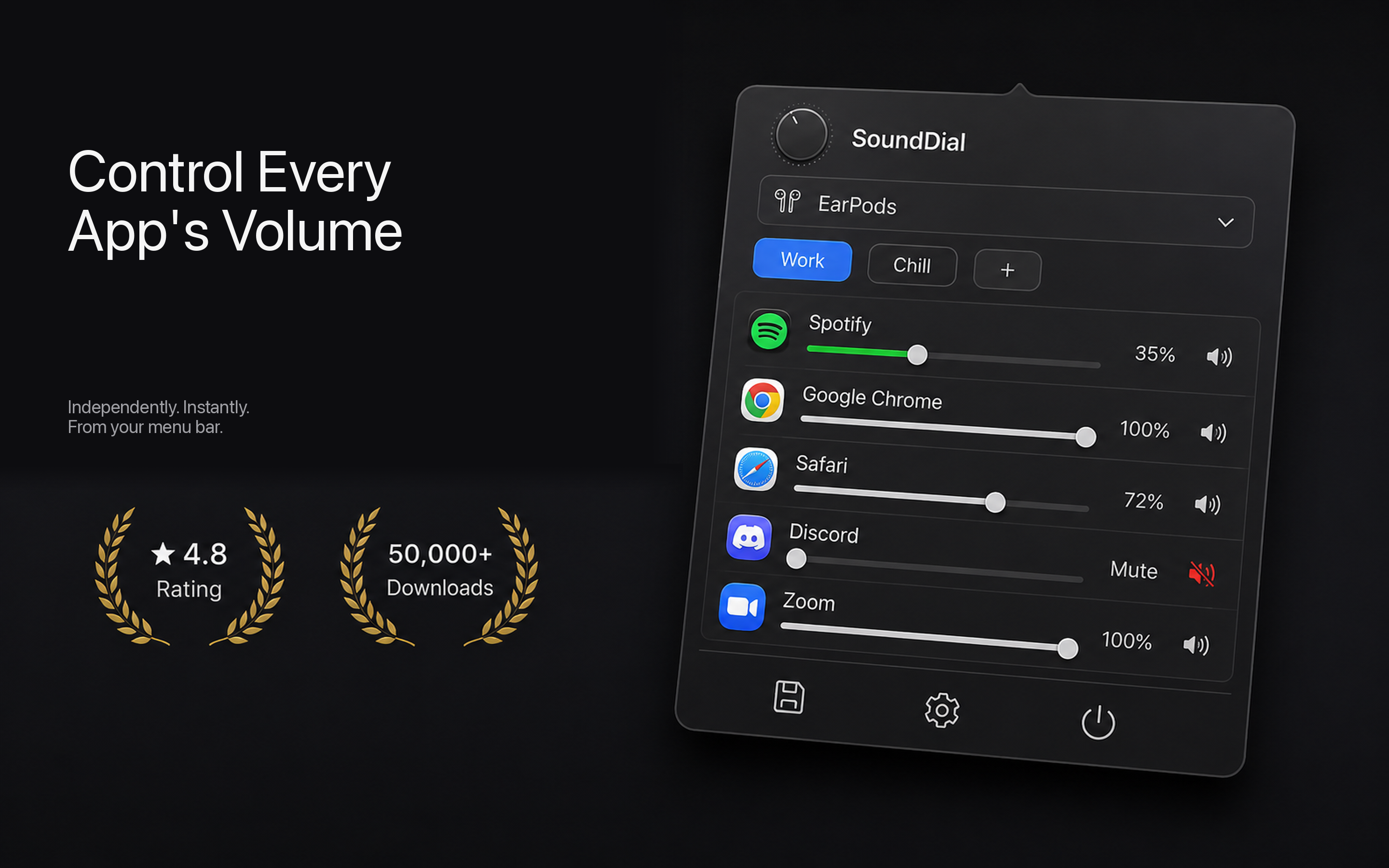
Key features:
- Per-app volume sliders — 0% to 200% range for every running app
- One-click mute — silence any app without moving its slider
- Volume profiles — save and switch between volume configurations
- Auto-ducking — music automatically lowers during calls
- Keyboard shortcuts — toggle the mixer or mute all apps with a hotkey
- Output device switching — change speakers/headphones from the same panel
- Volume memory — remembers each app's volume between restarts
One-time purchase. No subscription. macOS 14.2+. Get SoundDial on the Mac App Store.