If you have ever read the description of a security app, you have probably seen the term "AES-256 encryption." It sounds technical and impressive, but what does it actually mean? And more importantly, why should you care? This article breaks down AES-256 in plain language, explains why it is considered the gold standard in data security, and shows how it applies to protecting the files on your phone.
A Brief History of AES
AES stands for Advanced Encryption Standard. It was established by the U.S. National Institute of Standards and Technology (NIST) in 2001 after a five-year public competition to replace the aging Data Encryption Standard (DES). Fifteen candidate algorithms were submitted by cryptographers from around the world. After rigorous analysis, the Rijndael algorithm, created by Belgian cryptographers Joan Daemen and Vincent Rijmen, was selected as the winner.
Since its adoption, AES has become the most widely used encryption algorithm on the planet. It is an open standard, meaning its design is publicly available for anyone to inspect and scrutinize. Over two decades of analysis by the global cryptographic community have not revealed any practical weaknesses.
How AES-256 Works (Simply)
At its core, AES is a symmetric encryption algorithm. This means the same key is used to both encrypt and decrypt data. Think of it like a lock where the same key both locks and unlocks the door.
The process works like this:
- Your file (a photo, a document, a video) is broken into small, fixed-size blocks of 128 bits.
- Each block goes through multiple rounds of mathematical transformations: substitution, shifting rows, mixing columns, and adding the encryption key.
- AES-256 performs 14 rounds of these transformations per block (AES-128 uses 10 rounds, AES-192 uses 12). Each round further scrambles the data.
- The output is ciphertext: data that looks like random noise and is completely unreadable without the key.
The "256" in AES-256 refers to the key length: 256 bits. This is the maximum key size AES supports and provides the highest level of security.
Why 256 Bits Matters
The security of encryption depends on how hard it is to guess the key. A 256-bit key means there are 2 raised to the power of 256 possible key combinations. To put that number in perspective:
- 2 to the 256th power is approximately 1.15 times 10 to the 77th power. That is a 1 followed by 77 zeros.
- There are roughly 10 to the 80th power atoms in the observable universe. The number of possible AES-256 keys is in the same order of magnitude.
- If every computer on Earth worked together trying one billion keys per second, it would take longer than the age of the universe to try them all.
Brute-forcing AES-256 is not just difficult. It is physically impossible with any current or foreseeable technology, including quantum computers for the foreseeable future.
Who Uses AES-256?
AES-256 is not some niche algorithm used by a handful of apps. It is the backbone of global security infrastructure:
- U.S. Government and Military: AES-256 is approved for encrypting classified information up to the Top Secret level.
- Banks and Financial Institutions: Online banking, ATM networks, and payment processing all rely on AES.
- VPN Providers: Most reputable VPN services use AES-256 to encrypt your internet traffic.
- Messaging Apps: Signal, WhatsApp, and iMessage all use AES as part of their encryption protocols.
- Disk Encryption: Apple's FileVault, Microsoft's BitLocker, and Android's full-disk encryption all use AES-256.
- Cloud Storage: AWS, Google Cloud, and Azure encrypt stored data with AES-256.
AES-256 vs. Other Encryption Standards
You may encounter other encryption terms. Here is how they compare:
- AES-128: Same algorithm, shorter key. Still considered secure for most purposes, but AES-256 provides a wider safety margin.
- DES (Data Encryption Standard): The predecessor to AES, with a 56-bit key. Obsolete and easily crackable with modern hardware.
- 3DES (Triple DES): Applies DES three times for an effective 112-bit key. Slow and officially deprecated by NIST.
- RSA: An asymmetric algorithm (different keys for encryption and decryption) used primarily for key exchange, not bulk file encryption. RSA and AES are often used together.
- ChaCha20: A modern alternative to AES, popular in mobile devices because it is fast without hardware acceleration. Comparable security to AES-256.
Why It Matters for Your Photos and Files
When an app encrypts your files with AES-256, each file becomes unreadable without the correct decryption key. This means:
- If someone steals your phone and extracts the raw storage data, your encrypted files appear as meaningless noise.
- If a recovery tool scans your device for deleted files, any encrypted remnants are useless without the key.
- If a backup containing your encrypted files is compromised, the files remain protected.
The critical factor is whether the app actually encrypts each file or merely hides it in a different folder. Many apps claim "military-grade security" but use simple file-relocation techniques that offer zero protection against anyone who knows where to look. Always verify that the app explicitly names AES-256 as its encryption standard.
Encryption in Practice
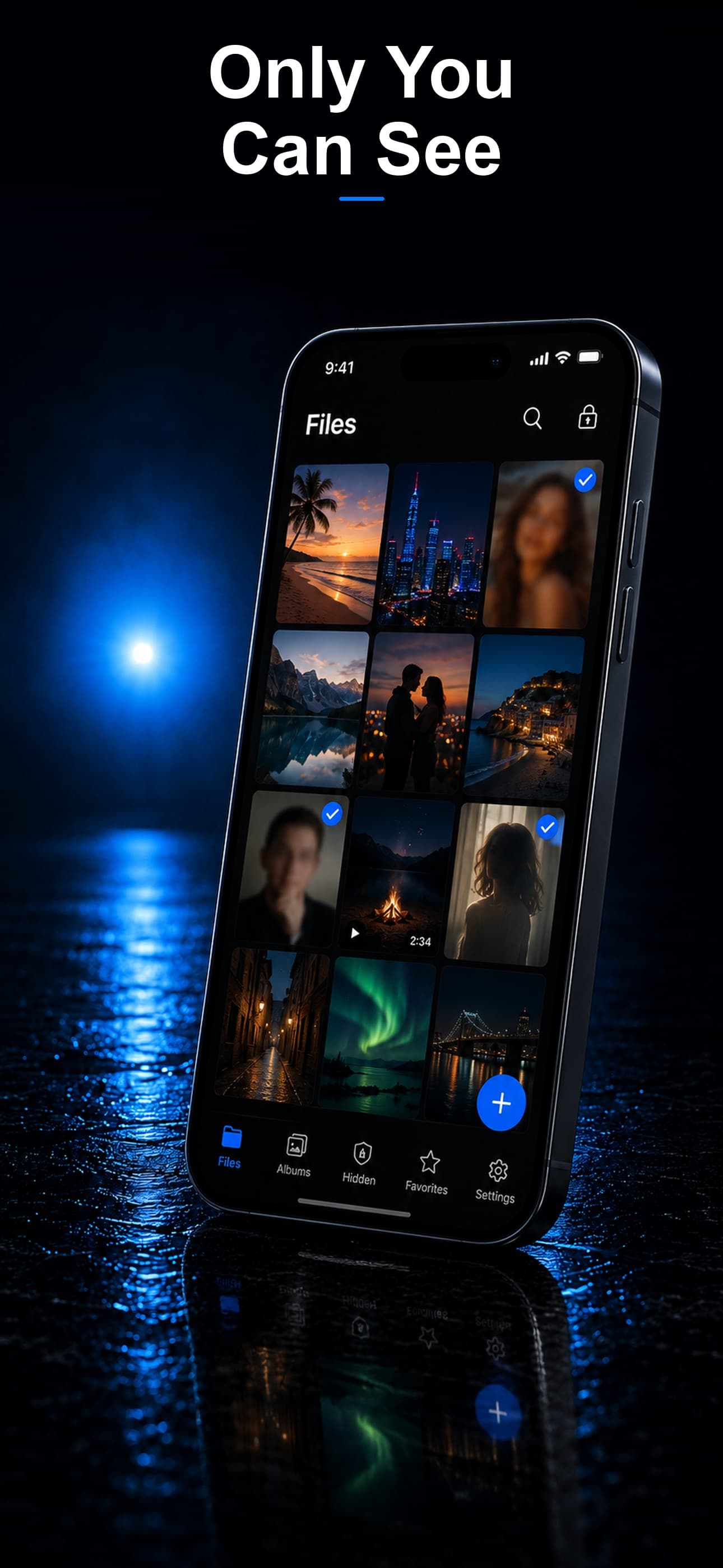
Stash applies AES-256 encryption to every file the moment it enters the vault: photos, videos, documents, and any other file type. The encryption key is derived from your personal passcode and never leaves your device. There is no cloud sync, no server-side key storage, and no way for anyone, including the app developer, to decrypt your files. Combined with a disguised interface, a decoy vault, and intruder detection, Stash puts the same encryption standard trusted by governments and banks directly on your iPhone. Download Stash from the App Store and protect your files with the strongest encryption available.