When a company says they use "zero-knowledge encryption," they are making a powerful claim: even they cannot see your data. In a world where data breaches, government subpoenas, and corporate surveillance are routine, zero-knowledge encryption represents the highest standard of privacy. But what does the term actually mean, how does it differ from regular encryption, and why should you care when choosing how to protect your photos?
Zero-Knowledge Encryption Defined
Zero-knowledge encryption means that the service provider has zero knowledge of the contents of your data. The encryption and decryption happen entirely on your device, using keys that only you possess. The provider stores your encrypted data but never has access to the keys needed to decrypt it.
Think of it this way: imagine you rent a storage unit. With standard security, the storage company keeps a master key that can open any unit. They promise not to use it, but the key exists. With zero-knowledge security, the storage company installs a lock but gives you the only key and destroys any copies. They physically cannot open your unit, no matter what.
How It Differs from Standard Encryption
Standard Cloud Encryption
Most cloud services encrypt your data, but they hold the encryption keys. This means:
- The service can decrypt and access your data whenever they want.
- Employees with sufficient access could theoretically view your files.
- If law enforcement presents a valid warrant, the service can hand over your data in readable form.
- If the service is breached and both encrypted data and keys are stolen, your data is exposed.
This is how most services operate by default, including Google Photos, Dropbox (standard tier), and iCloud without Advanced Data Protection.
Zero-Knowledge Encryption
With zero-knowledge encryption:
- The keys are generated and stored only on your device.
- The service never sees, stores, or transmits your keys.
- No employee, executive, or system at the service provider can decrypt your data.
- If law enforcement presents a warrant, the service can only hand over encrypted data that they cannot decrypt.
- If the service is breached, attackers get only encrypted data without the keys to read it.
The Trust Problem
Standard encryption requires you to trust the service provider. You trust that they will not access your data, that their employees will not abuse their access, that their security practices will prevent breaches, and that they will resist improper government requests. That is a lot of trust to place in any organization.
Zero-knowledge encryption replaces trust with mathematics. You do not need to trust the provider because they are structurally unable to access your data. The encryption guarantees privacy regardless of the provider's intentions, competence, or legal obligations.
Services That Use Zero-Knowledge Encryption
Several services have adopted zero-knowledge models:
- Signal: Messages are end-to-end encrypted. Signal cannot read your messages even with a warrant.
- ProtonMail: Emails are encrypted with keys only the user holds. Proton cannot decrypt your emails.
- Tresorit: A cloud storage service that encrypts files on your device before upload, with zero knowledge by the provider.
- iCloud with Advanced Data Protection: When this opt-in feature is enabled, Apple no longer holds the keys to most iCloud data categories, including Photos.
- Bitwarden: The password manager encrypts your vault locally, and Bitwarden's servers never see your master password or decrypted vault contents.
Zero-Knowledge vs. End-to-End Encryption
These terms are related but not identical:
- End-to-end encryption (E2E) typically refers to communication: data is encrypted on the sender's device and only decrypted on the recipient's device, with no one in between (including the service) able to read it.
- Zero-knowledge encryption is a broader concept that applies to storage as well as communication. A zero-knowledge storage service encrypts data on your device, stores the ciphertext, and never has the ability to decrypt it.
All zero-knowledge services use end-to-end encryption for data in transit, but not all E2E encrypted services are zero-knowledge. The distinction matters when your data is stored somewhere: E2E protects data in motion, zero-knowledge protects data at rest on the provider's servers.
The Trade-Off: Convenience
Zero-knowledge encryption has one significant trade-off: if you lose your encryption key (your password or passcode), no one can help you recover your data. The provider cannot reset your password and decrypt your files because they do not have the keys. This is the price of true privacy: full control also means full responsibility.
Some services offer recovery mechanisms like recovery keys or trusted contacts, but these must be set up in advance. If you forget your passcode and have no recovery method, your data is permanently inaccessible. This is not a bug; it is the direct consequence of genuine zero-knowledge architecture.
Why It Matters for Your Photos
Photos are uniquely sensitive data. They capture faces, locations, relationships, medical conditions, and private moments. Unlike a password that can be changed after a breach, a leaked photo is permanently compromised. For this type of data, zero-knowledge encryption is not overkill; it is proportionate.
When your photos are protected by zero-knowledge encryption:
- No company can scan, analyze, or view them.
- No government request can produce readable copies from the provider.
- No data breach can expose your photos because the stolen data is unreadable.
- No employee, contractor, or hacker who compromises the provider gains anything useful.
The On-Device Advantage
The purest form of zero-knowledge for photos is on-device encryption with no cloud component at all. When your encrypted photos never leave your device, the "zero-knowledge" guarantee is absolute. There is no server to breach, no provider to subpoena, and no transmission to intercept. The encrypted files exist in one place: your phone, protected by a key only you possess.
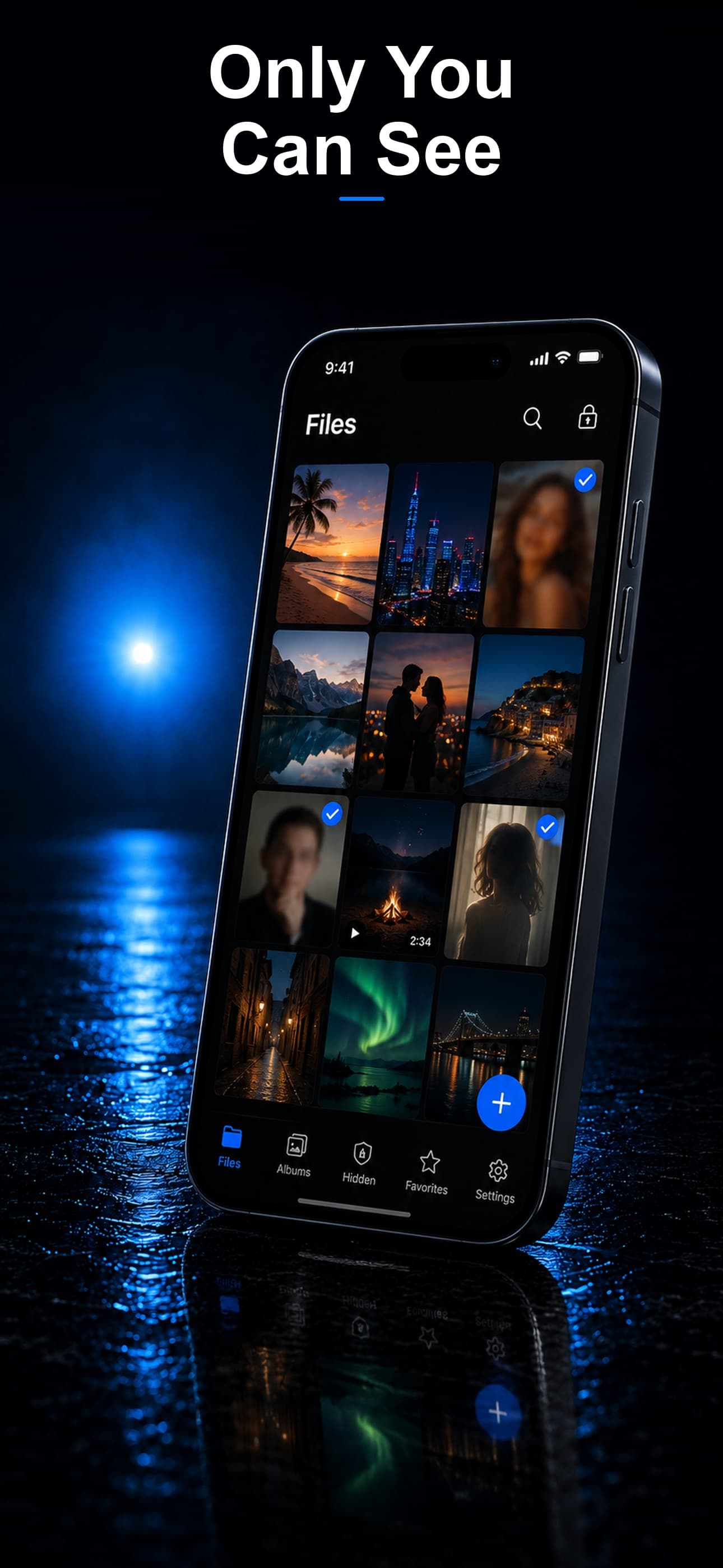
Stash implements this model completely. Every file is encrypted with AES-256 on your device, the encryption key is derived from your personal passcode, and nothing ever touches a server. It is zero-knowledge not by policy but by architecture: the app has no server, no account system, and no way to access your data. Download Stash from the App Store and experience zero-knowledge privacy in its simplest and strongest form.