You updated macOS. Everything seemed fine — until you noticed there's no sound. Or sound is crackling. Or the volume is stuck. Or your audio output device is gone. Post-update audio issues happen with nearly every macOS release, and they range from mildly annoying to completely silent.
Here's a systematic guide to fixing Mac audio after a macOS update, covering every known issue and solution.
Step 1: Check the obvious
Is it muted?
Press the volume-up key. Check if the volume indicator appears on screen. Sometimes updates reset the system volume to zero or enable mute.
Is the right output device selected?
Go to System Settings → Sound → Output. After an update, macOS sometimes switches to an unexpected output device — a connected monitor's speakers, a Bluetooth device that's not connected, or the built-in speakers when you want external ones. Select the correct device.
Is Headphone Safety limiting volume?
Updates sometimes reset Headphone Safety to its default (enabled). Check System Settings → Sound → Headphone Safety and disable "Reduce Loud Audio" if it was turned on by the update.
Step 2: Restart Core Audio
The audio daemon (coreaudiod) often gets into a bad state after an update. Restarting it is the single most effective fix.
Open Terminal and run:
sudo killall coreaudiod
Audio will cut out briefly and restart. Test if sound is working now. If this fixes it, the issue was a stale audio daemon state — common after updates.
Step 3: Reset NVRAM/PRAM
For Intel Macs: shut down completely, then power on while holding Option + Command + P + R for about 20 seconds. This resets the NVRAM, which stores volume settings, startup disk selection, and other low-level preferences.
For Apple Silicon Macs (M1/M2/M3/M4): NVRAM resets automatically when needed. A full restart (not just sleep/wake) is usually sufficient.
Step 4: Check for third-party audio driver conflicts
macOS updates frequently break third-party audio drivers and kernel extensions. If you have any of these installed, they might be causing the issue:
- Soundflower — discontinued, often conflicts with newer macOS
- BlackHole — virtual audio device, may need updating after macOS updates
- Loopback — may need a new version for the updated macOS
- Background Music — installs a virtual audio device that frequently breaks on updates
- Audio interface drivers — Focusrite, Universal Audio, etc. check for updated drivers
Fix: Remove or update the conflicting software. For virtual audio devices, check if the audio device installed by the app appears in System Settings → Sound → Output — if it does and it's selected, switch to your real speakers. Then update or uninstall the third-party app.
Step 5: Safe Mode boot
Boot into Safe Mode to determine if the issue is caused by a startup item or third-party extension:
- Apple Silicon: Shut down → hold the power button until "Loading startup options" appears → select your startup disk → hold Shift → click "Continue in Safe Mode"
- Intel: Restart → hold Shift during boot until you see the login window
If audio works in Safe Mode, a third-party kernel extension or login item is the cause. Investigate recently installed software.
Step 6: Create a new user account
If the issue persists, create a temporary new user account (System Settings → Users & Groups → Add User). Log into the new account and test audio. If sound works in the new account, the issue is with your user profile — a corrupted preference file or audio configuration.
Preventing future issues with SoundDial
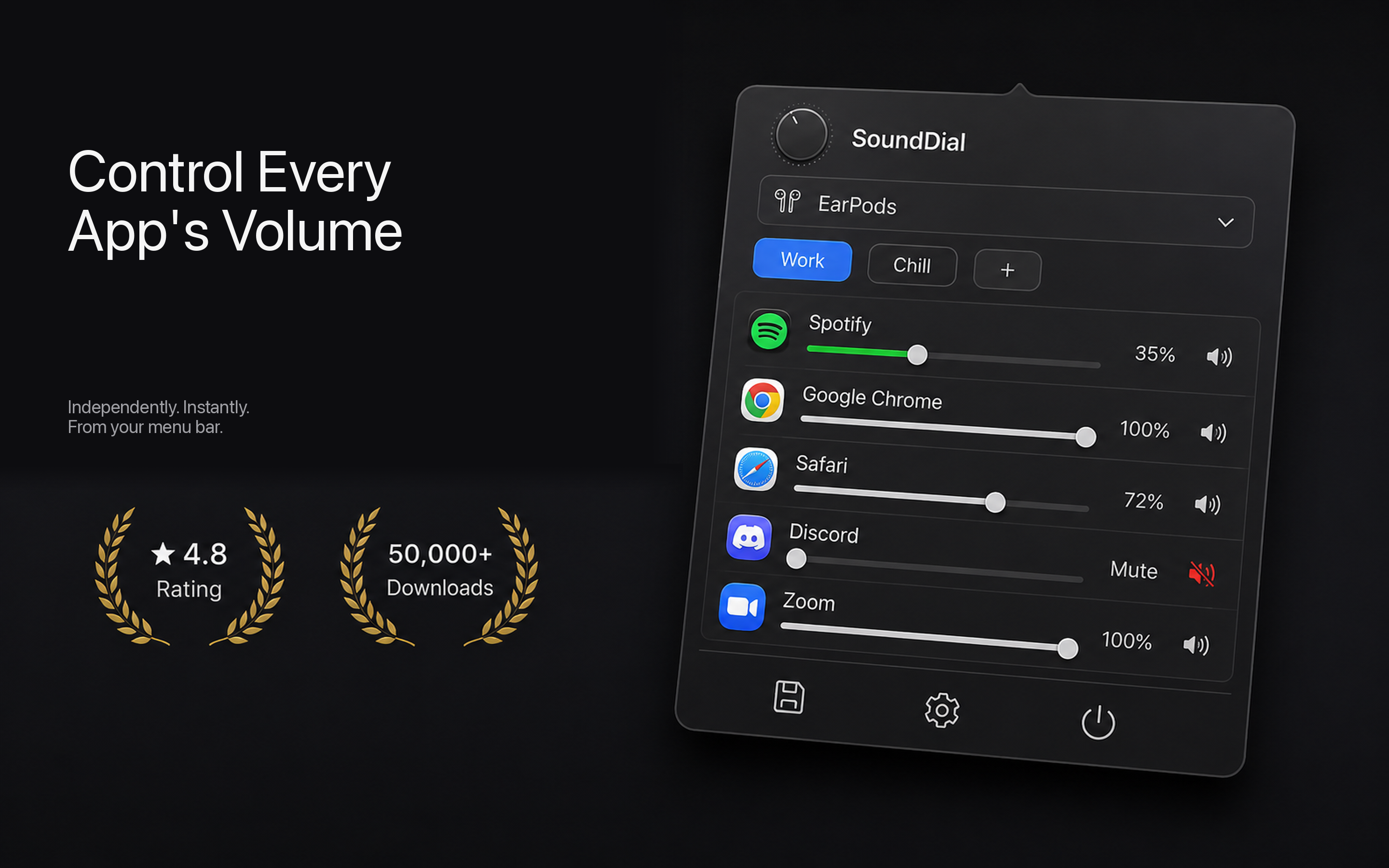
One advantage of SoundDial over other audio tools: it doesn't install a system audio driver. It uses Apple's native Core Audio Tap API, which means it works cleanly with macOS updates without the conflicts that plague virtual audio device apps.
If you've been using Background Music or Soundflower and they broke after an update, SoundDial is a replacement that won't have the same problem. Per-app volume control, volume boost to 200%, profiles, auto-ducking — all without a kernel extension or virtual audio device.
Available on the Mac App Store — Apple-reviewed, €14.99 one-time purchase, no subscription, macOS 14.2+.