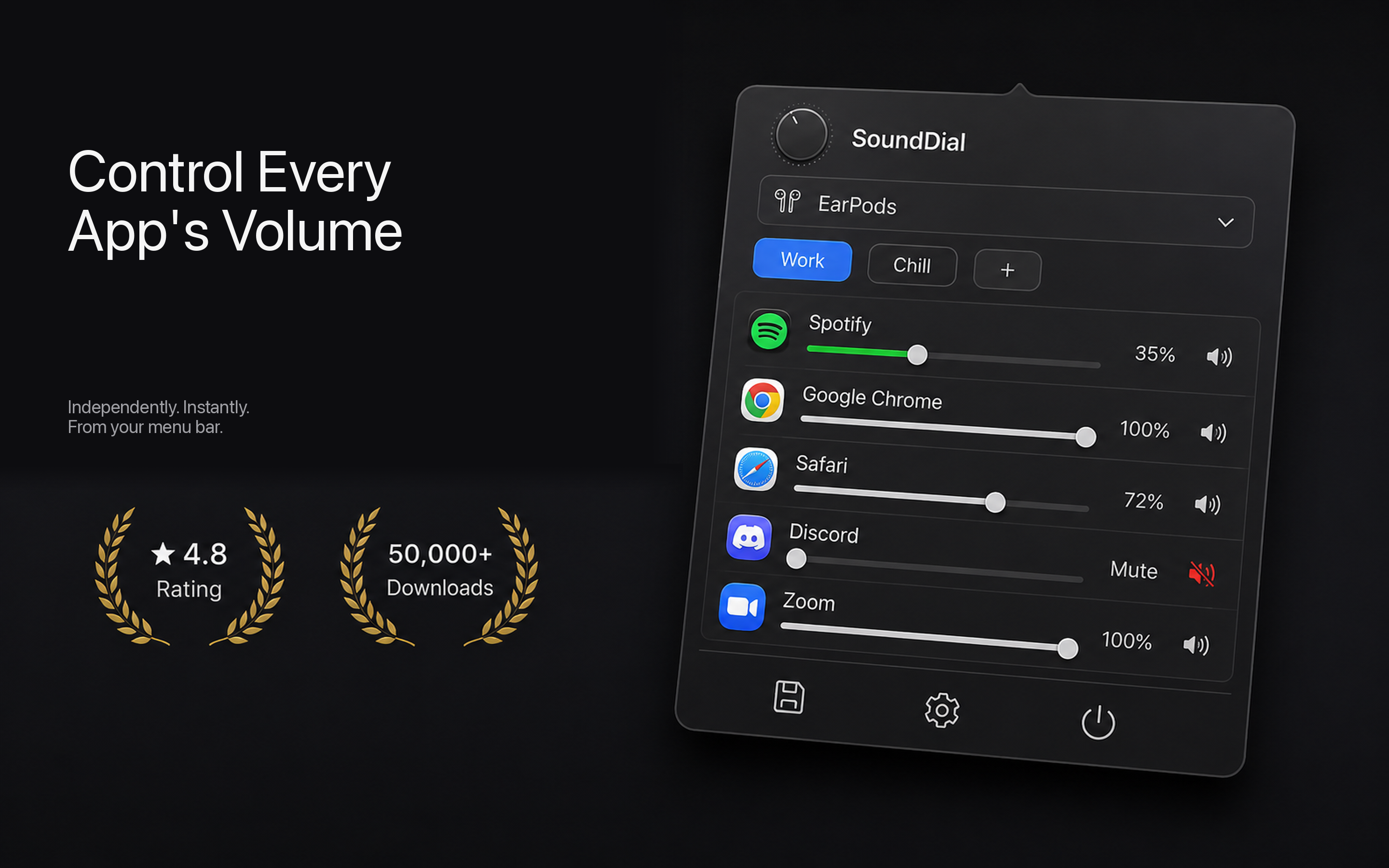
If Background Music has stopped working after a macOS update, the most reliable alternative is SoundDial — a menu-bar per-app volume mixer from the Mac App Store. It gives every app its own volume slider, adds mute, boost, volume profiles, and auto-ducking, and it's fully sandboxed and Apple-reviewed, so there are no audio drivers to break on the next macOS release.
Why Background Music breaks on newer macOS
Background Music is a genuinely clever free, open-source project. It gave Mac users something Apple never has: a per-app volume mixer, the kind Windows has had for years. But its design is also the reason it keeps failing.
To route and control audio, Background Music installs a virtual audio device — a system-level driver that intercepts your Mac's sound. That approach worked well on older macOS, but every major release tightens security around kernel and audio extensions. The common symptoms users report:
- No sound at all after installing or after an OS update.
- The virtual device fails to load, so audio routing silently stops.
- The app needs a reinstall, a reboot, or manual driver removal to recover.
- Development is community-driven and volunteer-paced, so fixes for a new macOS can lag.
None of this makes Background Music "bad." It just means a free driver-based tool is fragile by nature, and if you rely on per-app volume every day, that fragility gets old fast.
What to look for in a replacement
Before picking any alternative, decide what you actually need:
- Reliability across macOS updates. If it installs a kernel or audio extension, expect occasional breakage.
- Real per-app control. Independent volume and mute for each app is the baseline.
- Boost. Some apps (quiet meeting tools, certain browsers) are simply too quiet — you want to push past 100%.
- Convenience features. Profiles and auto-ducking are what turn a utility into something you keep open all day.
- Safe install. A sandboxed Mac App Store app can't touch system internals, so uninstalling is clean and updates are automatic.
Why SoundDial is the reliable pick
SoundDial was built to solve exactly the problem Background Music users run into: they want per-app volume, but they don't want to babysit a driver. It lives in your menu bar and does the core job well:
- Independent volume for every app, with per-app mute in the same panel.
- Per-app boost to make quiet apps loud enough to actually hear.
- Volume profiles — save a mix (say, "meeting" or "gaming") and switch instantly instead of dragging sliders every time.
- Auto-ducking, so background audio dips automatically when it should.
- Quick output switching between speakers, headphones, and other devices.
The bigger difference is how it installs. SoundDial ships through the Mac App Store, which means it's Apple-reviewed and sandboxed. There's no DMG to drag, no audio driver or system extension, and no kernel access. That's the single most important reason it won't break the way Background Music does when a new macOS arrives — it isn't wired into the parts of the system that Apple keeps locking down.
It costs €14.99 one-time. Not free, but there's no subscription, and you're paying for something maintained and safe to install.
SoundDial vs. Background Music vs. the free tools
Background Music isn't your only free option, so here's an honest lay of the land:
- Background Music (free, open-source): per-app volume, but driver-based, prone to breaking on newer macOS, and it lacks boost, profiles, and auto-ducking.
- FineTune (free, open-source): a lightweight menu-bar per-app volume app. Good if free is your only requirement, but thin on the extras.
- eqMac (free): primarily a system EQ and booster, not a true per-app mixer.
- SoundSource by Rogue Amoeba (~$39): the pro-grade option, with per-app EQ and full output routing. Excellent, but it's more than double SoundDial's price and still requires a download plus an audio capture driver.
- SoundDial (€14.99, Mac App Store): the middle ground — real per-app volume, mute, boost, profiles, and ducking, delivered as a clean sandboxed install with no drivers.
If you need per-app EQ or complex studio routing, SoundSource is worth the extra money. If you want a free tinkerer's tool and can tolerate the occasional breakage, FineTune or Background Music will do. But if your goal is "give every app its own volume and stop having it break every macOS update," SoundDial hits that target for the least hassle.
The macOS context that makes this necessary
It's worth saying plainly: macOS has no built-in per-app volume mixer. Windows has had one for years in its volume flyout, but on a Mac the system slider controls everything at once. That gap is the entire reason tools like Background Music and SoundDial exist. Since Apple isn't filling it, the practical question is just which third-party approach you trust — a free driver that fights the OS, or a sandboxed app that works with it.
Ready to stop fighting broken audio drivers? Get SoundDial on the Mac App Store for €14.99 and control every app's volume the reliable way.