If you just want per-app volume control that installs cleanly and costs less, SoundDial is the better buy for most people: €14.99 one-time, from the Mac App Store, with per-app volume, mute, boost, profiles, and auto-ducking. Pick Rogue Amoeba's SoundSource (~$39) only if you specifically need per-app EQ and advanced output routing.
The short version
macOS still has no built-in per-app volume mixer. Windows has had one for years, but on a Mac the system volume slider moves everything at once. Both SoundSource and SoundDial exist to fix that gap. They just aim at different buyers.
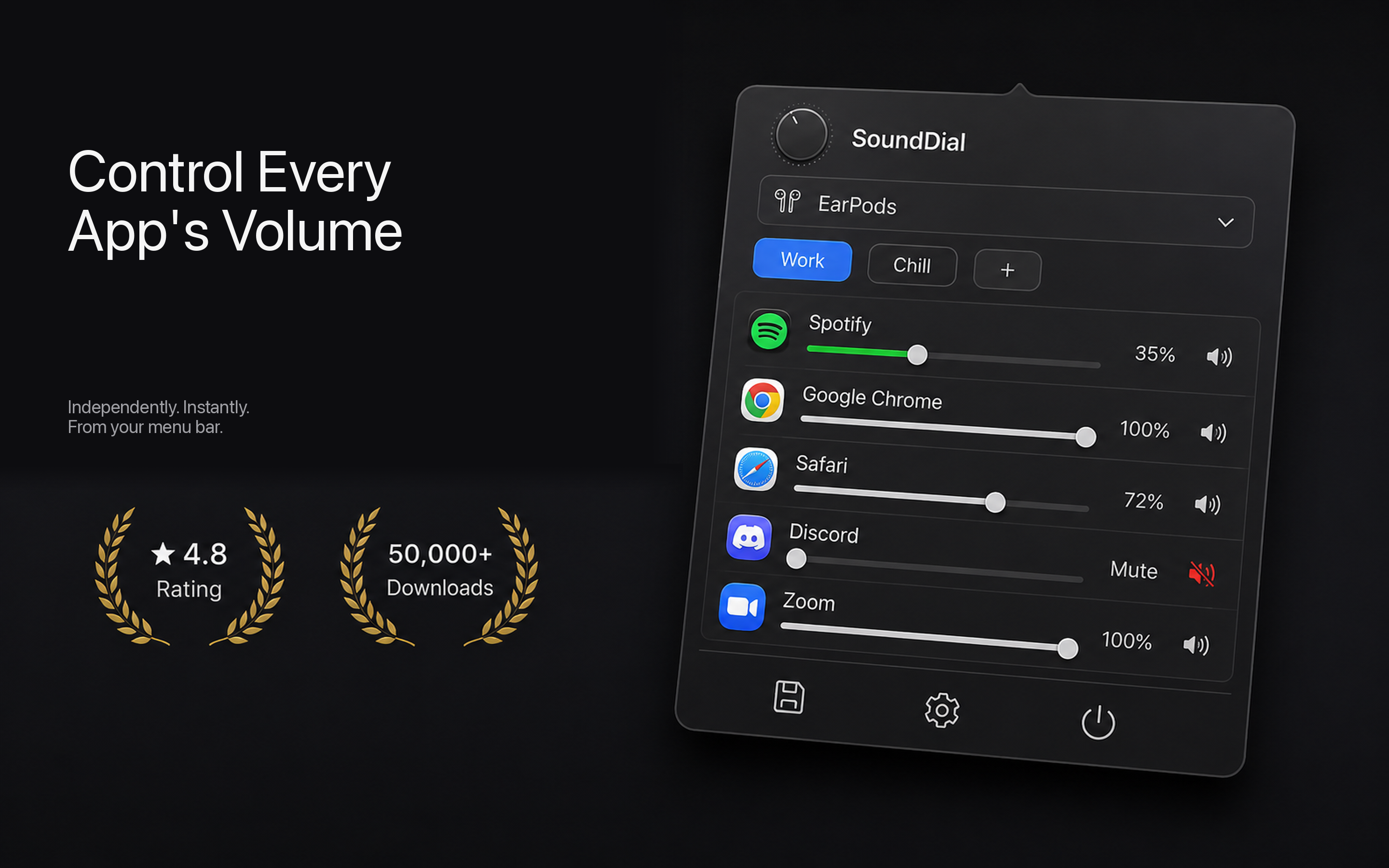
- SoundDial — €14.99 one-time, Mac App Store, menu-bar app. Independent volume per app, per-app mute, per-app boost, saved profiles, auto-ducking, and quick output switching. Sandboxed and Apple-reviewed, so no driver install.
- SoundSource — ~$39, direct download from Rogue Amoeba. Everything above plus per-app EQ, advanced output routing, and audio effects. Requires a small audio-capture driver to be installed.
Price and how you buy it
This is the clearest split. SoundSource is roughly $39 and sold directly by Rogue Amoeba. SoundDial is €14.99 as a one-time purchase on the Mac App Store — a little over a third of the price.
Because SoundDial ships through the App Store, it's sandboxed, notarized, and Apple-reviewed. You click Get, it installs, and it's done. There's no DMG to mount, no permissions to grant to a kernel-adjacent component, and no audio driver or system extension. It also rides along with your normal App Store update flow and syncs to your other Macs on the same Apple ID.
SoundSource downloads outside the App Store and installs an audio-capture driver so it can intercept and process each app's audio. That's what unlocks its pro features, but it also means an extra install step and a component that lives deeper in the system.
What SoundSource does that SoundDial doesn't
SoundSource earns its price for a specific kind of user. If any of these describe you, it's worth the extra money:
- Per-app EQ. You want a 10-band equalizer on, say, Spotify while leaving Zoom flat. SoundDial does volume, not EQ.
- Advanced output routing. Sending one app to your speakers and another to headphones or a specific interface, with fine control.
- Audio effects and plugins. SoundSource can host effects on a per-app basis — genuinely pro territory.
Rogue Amoeba has a long, trusted track record. SoundSource is a serious tool and it's priced like one. If you're an audio pro or a heavy multi-output user, it's the right call.
What SoundDial does better for everyday use
Most people who search for a "Mac volume mixer" don't need an EQ. They need one app quieter than another, and they don't want to fight an installer to get it. SoundDial covers that cleanly, and adds a couple of things worth calling out:
- Per-app boost. Some apps and videos are just too quiet even at 100%. SoundDial can push a single app above its normal ceiling so a quiet meeting or podcast is finally audible.
- Volume profiles. Save a full setup — music low, browser muted, call app loud — and recall it instantly. Great for switching between "focus," "meeting," and "gaming" without dragging five sliders.
- Auto-ducking. Automatically dip background audio (like music) when another source starts, so notifications, calls, or video don't get buried.
- Quick output switching. Jump between speakers, headphones, and other devices from the menu bar.
All of that runs from a menu-bar dropdown, so it's a click away and out of your face the rest of the time.
The free alternatives, briefly
You'll see a few free options mentioned in the same searches. They're worth knowing about:
- Background Music — free and open-source, gives you basic per-app volume. But it can break on newer macOS releases, and it has no boost, profiles, or auto-ducking.
- FineTune — a free open-source menu-bar volume app. Simple, but limited in scope.
- eqMac — free EQ and system booster, more of a system-wide EQ tool than a true per-app mixer.
Free is great if it works for you. The tradeoff is compatibility and support: open-source audio tools can lag behind macOS updates, and features like profiles and ducking generally aren't there. If your setup matters to your workday, paying once for something reviewed and maintained is usually the calmer path.
Which one should you buy?
Answer one question: do you need per-app EQ or advanced output routing?
- Yes — buy SoundSource. It's built for that, and the ~$39 is fair for a pro tool with a driver-level engine.
- No, I just want per-app volume, boost, and a clean install — buy SoundDial. You get the mixing that actually matters day to day, plus profiles and auto-ducking, for €14.99 and zero driver hassle.
For the large majority of Mac users, that second bucket is the honest answer. You're paying for control over volume, not for a studio.
Ready to fix Mac volume the easy way? Get SoundDial on the Mac App Store — €14.99 one-time, no drivers, no DMG. Per-app volume, boost, profiles, and auto-ducking in one click.