You want per-app volume control on your Mac. You've found two categories of tools: virtual audio drivers (like Loopback, BlackHole, or the driver component in SoundSource) and lightweight menu-bar mixers (like SoundDial or Background Music). Both promise independent app volume control. But they achieve it through fundamentally different mechanisms, and the trade-offs matter.
How virtual audio drivers work
A virtual audio driver creates a fake audio device in macOS. Apps send their audio to this virtual device, and the driver software routes it onward — potentially splitting, mixing, or processing the streams along the way. This is powerful: you can send different apps to different physical outputs, apply per-app EQ, record individual app streams, and build complex routing matrices.
The trade-offs:
- System-level installation: drivers modify your audio subsystem. They require security approval and sometimes a restart.
- macOS update fragility: Apple frequently changes audio frameworks. Drivers can break after a major update, leaving you with no audio until the developer patches it.
- Complexity: routing matrices and virtual devices are powerful but confusing if you just want one app quieter.
- Not on the App Store: apps that install drivers can't be distributed through the Mac App Store due to sandboxing restrictions.
How SoundDial works
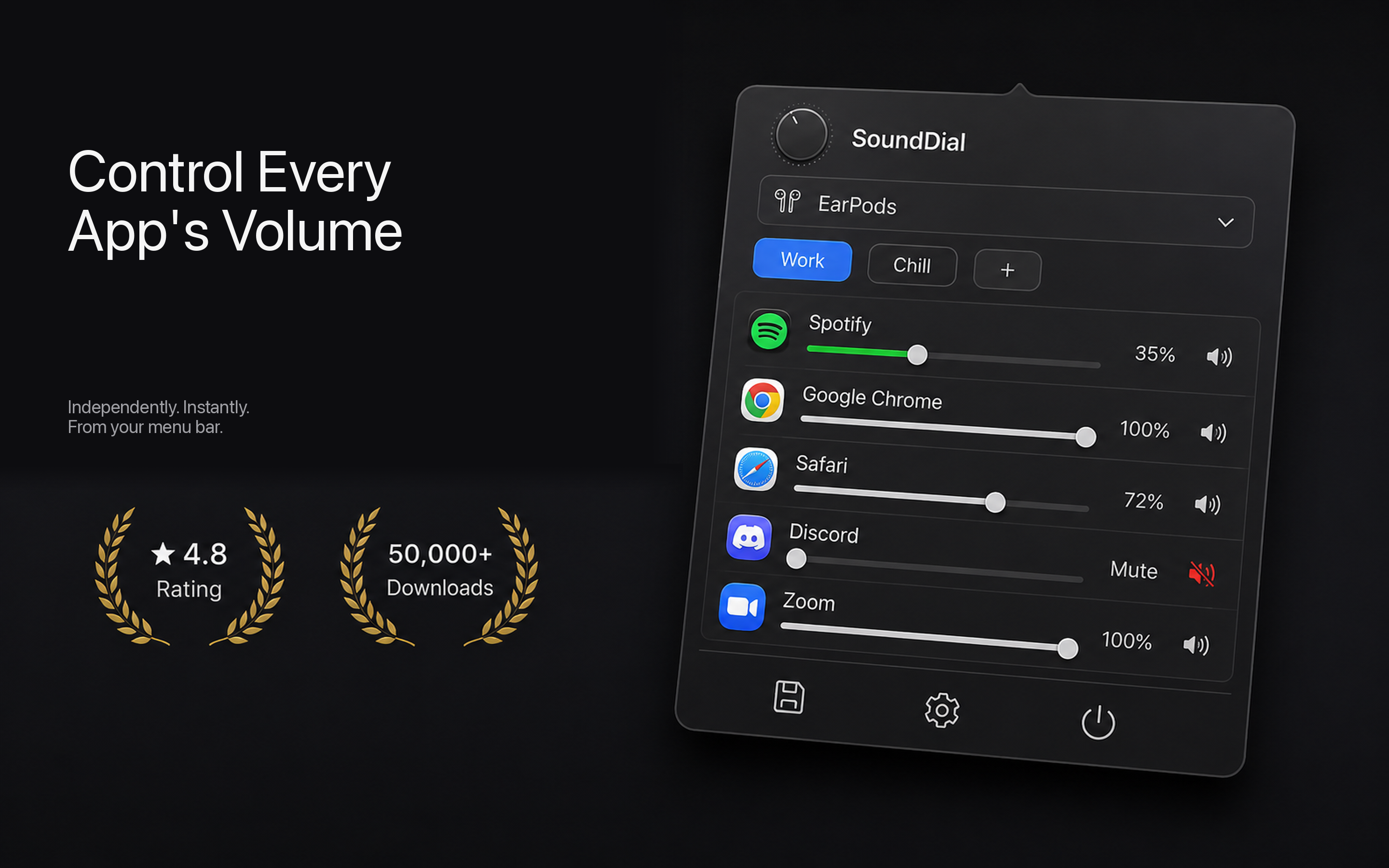
SoundDial takes a different approach. It uses macOS APIs to control the volume of each app's audio stream without installing any driver or virtual device. No fake audio devices appear in your Sound settings. No system modification is required.
The trade-offs:
- No complex routing: SoundDial controls volume, mute, and boost per app — it doesn't route apps to different physical outputs or apply per-app EQ.
- App Store sandboxed: installs and uninstalls cleanly, no security prompts for drivers, no restart needed.
- macOS update resilience: since it doesn't modify the audio subsystem, it's less likely to break after OS updates.
- Simplicity: a slider per app, profiles, auto-ducking. No routing diagram to configure.
Which one should you choose?
Be honest about what you actually need:
- Choose a virtual audio driver if you need to route specific apps to specific physical outputs (e.g., game to headphones, music to speakers simultaneously), record individual app audio streams, or apply per-app effects and EQ. Loopback or SoundSource are the best options here.
- Choose SoundDial if you need per-app volume control, per-app mute, boost above 100%, volume profiles, and auto-ducking — without the complexity and fragility of a driver installation. This covers what most people actually need.
Most people searching for "per-app volume control" want the second option. They want Spotify quieter during a call, or Discord louder than their game. That doesn't require a virtual audio device — it requires a volume slider per app, which is exactly what SoundDial provides without touching your audio subsystem.
Get SoundDial on the Mac App Store — €14.99 one-time purchase, no subscription, macOS 14.2+.