macOS has no built-in way to set a different volume for each app, so you need a menu-bar volume mixer. The fastest, most reliable fix is SoundDial, a Mac App Store app that gives every application its own volume slider, per-app mute, and a boost that pushes quiet apps past 100%. Set your levels once and they stick.
Why Mac has no per-app volume control
If you've switched from Windows, you've probably gone looking for the equivalent of the Windows Volume Mixer, that little panel where each app has its own slider. It isn't there. macOS only offers one global system volume. Whether it's a YouTube video, a Zoom call, Spotify, or a game, they all share the same master level.
That's fine until it isn't. Discord chat drowns out your music. A browser ad blasts at full volume while your podcast plays quietly underneath. Your game is deafening but the voice call in the background is too soft. The only "solution" Apple gives you is to open each app and adjust its internal volume manually, if the app even has one, and redo it every session.
To get real per-app control, you need a small utility that sits between your apps and your output device. Below is how to do it properly, plus honest notes on the alternatives.
The fastest way: SoundDial (Mac App Store)
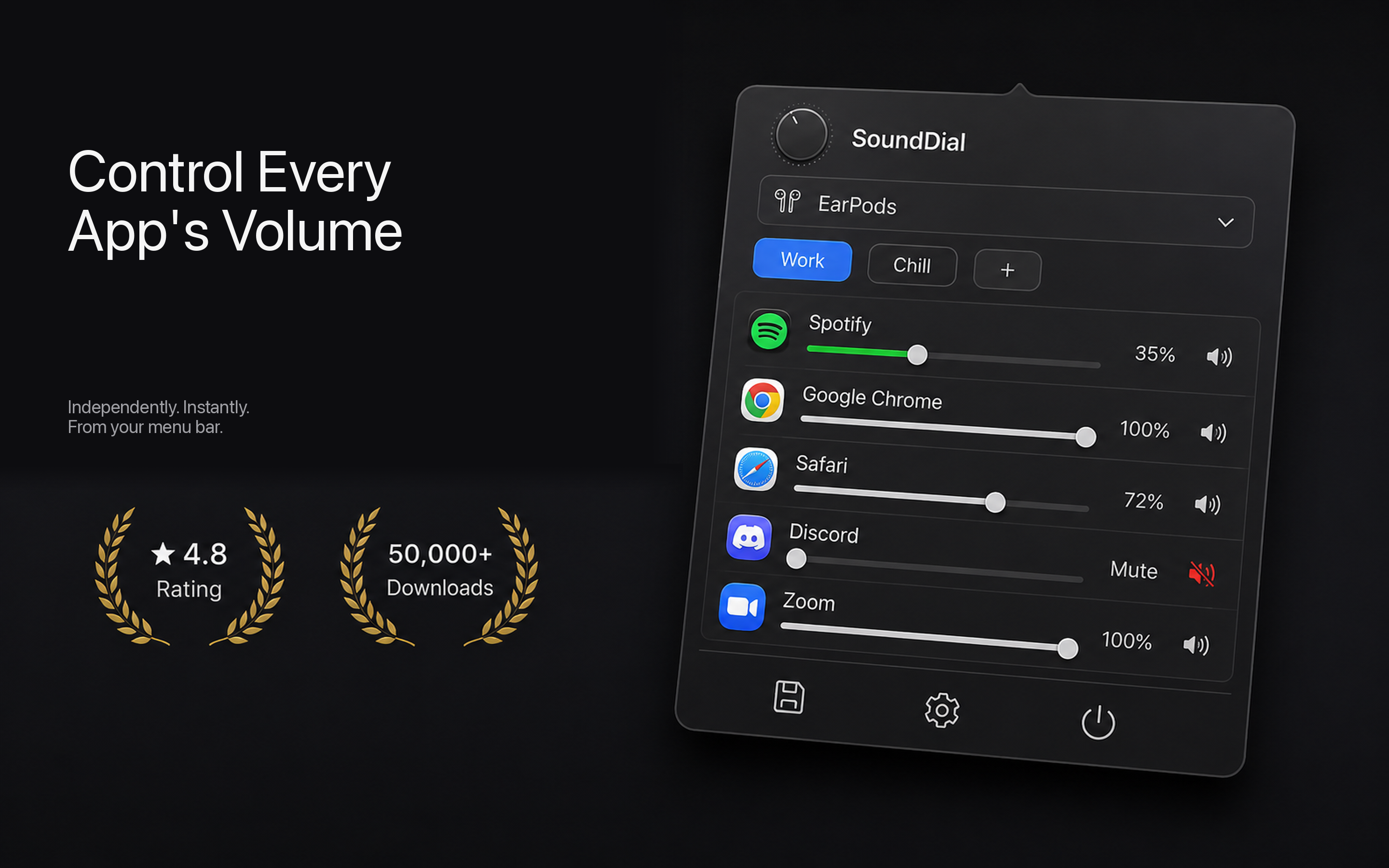
SoundDial lives in your menu bar and lists every app that is currently playing audio. Each one gets an independent slider. Here's the whole workflow:
- Install from the Mac App Store. It's Apple-reviewed and sandboxed, so there's no DMG, no audio driver, and no kernel or system extension to approve. It installs like any normal app and can be removed the same way.
- Click the menu-bar icon. You'll see a slider for each active app, plus a master control.
- Drag to set levels. Turn Discord down, nudge Spotify up, mute a noisy browser tab's app entirely with one click.
- Boost quiet apps. If an app is too soft even at 100%, push it above 100% with per-app boost.
- Save a profile. Store your "gaming," "work call," or "music" mix and switch between them instantly instead of re-dragging sliders every day.
Two features are worth calling out because they solve the most annoying scenarios:
- Auto-ducking automatically lowers other apps when a chosen app plays, so your music dips when a call comes in and returns afterward, no manual fiddling.
- Quick output switching lets you jump between headphones and speakers from the same menu without diving into System Settings.
Because levels are remembered per app and saved into profiles, this is the part most people actually want: you set it once and it stays set.
The free and paid alternatives, honestly compared
SoundDial isn't the only option, and depending on your needs, a free tool might be enough. Here's a fair rundown.
SoundSource (Rogue Amoeba)
SoundSource is the pro-grade heavyweight. Alongside per-app volume it does per-app EQ and full output routing, so you can send one app to headphones and another to speakers. It's genuinely excellent. The tradeoffs: it costs around $39, and it isn't a clean App Store install, it's a direct download that requires an audio-capture driver to be added to your system. If you're an audio professional who needs EQ and routing, it's worth it. If you just want each app at the right volume, it's more tool and more setup than you need.
Background Music (open-source, free)
Background Music is a free, open-source app that offers per-app volume and auto-pause. The catch is reliability: it installs a virtual audio device and has a history of breaking on newer macOS releases, sometimes requiring reinstalls or fixes after updates. It also lacks boost, saved profiles, and true auto-ducking. Great if you want free and don't mind occasional maintenance.
FineTune and eqMac
FineTune is a free, open-source menu-bar app, a lightweight starting point. eqMac is a free equalizer with a system-wide booster, aimed more at EQ and overall gain than at giving each app its own persistent slider. Both are worth trying if your need is narrow, but neither centers on the "different volume per app, saved as profiles" workflow.
Which should you choose?
- Want it to just work, cleanly, with profiles and auto-ducking? SoundDial at €14.99 one-time, from the App Store, with no drivers to install.
- Need per-app EQ and audio routing and don't mind the price or the driver? SoundSource.
- Want free and are okay tinkering when macOS updates? Background Music, FineTune, or eqMac.
The real advantage of SoundDial is the combination: independent volume, mute, and boost for every app, saved into switchable profiles, with automatic ducking, all inside a sandboxed App Store download you can trust and uninstall in a click, for a one-time €14.99 rather than a subscription.
No driver, no extension, no DMG. Set each app's volume once, save it as a profile, and let auto-ducking handle the rest.
Ready to give every app its own volume? Get SoundDial on the Mac App Store and set your perfect mix in about a minute.