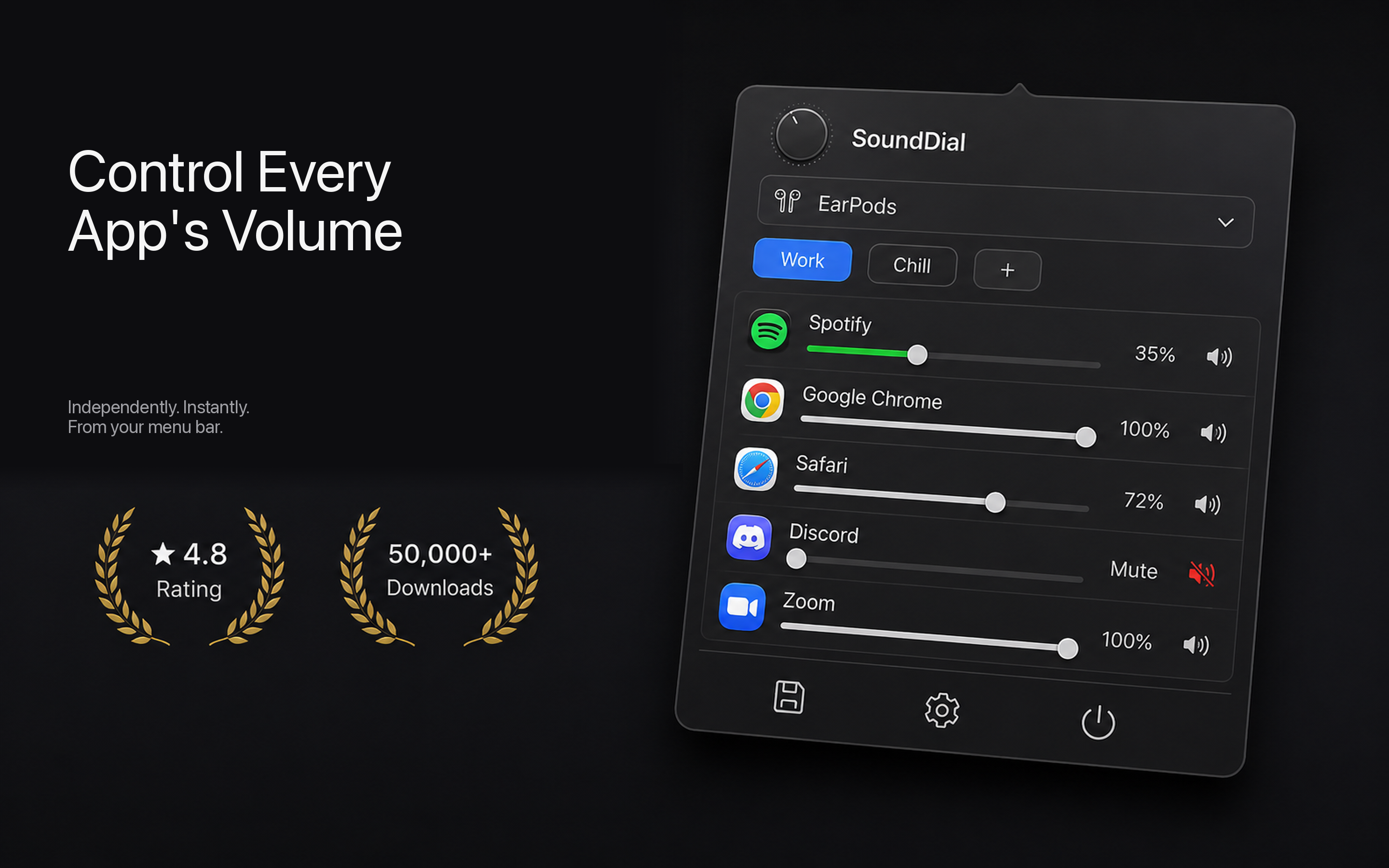
If you liked Boom 2 for system-wide boost but want simple per-app volume on a current Mac, the honest answer is that Boom 2 is legacy and no longer the right tool. A focused alternative is SoundDial, a menu-bar mixer that gives each app its own volume slider, mute, and boost, for €14.99 once, with no push to a bigger bundle.
Why Boom 2 no longer fits
Boom 2 was a well-loved app for a specific reason: it boosted your Mac's overall volume beyond the system maximum and added an equalizer. It did that system-wide, not per app. That was fine in 2015. In 2026 it has two problems.
First, it's legacy. Global Delight has clearly moved its energy to Boom 3D, and if you open the Boom 2 product page you'll find yourself nudged toward the newer, pricier app almost immediately. Boom 2 still exists, but it's a stepping stone the vendor uses to sell Boom 3D, not a product getting active love.
Second, and more important: Boom 2 was never a per-app volume mixer. It raises and shapes one master output. If your actual pain is that a Slack ping is louder than your music, or a browser tab is drowning out a call, Boom 2 doesn't solve that. It makes everything louder together. That's a different job.
What "per-app volume" actually means on macOS
Here's the honest context that most alternative round-ups skip: macOS has no built-in per-app volume mixer at all. Windows has had one for years — right-click the speaker, open the Volume Mixer, and set Chrome to 40% and Spotify to 80%. Apple never shipped that. The macOS volume key only moves one master level.
So when you look for a "Boom 2 alternative," what you're often really looking for isn't a louder Mac — it's the per-app control Windows users take for granted. That's a genuine gap in the operating system, not something Boom 2 or any single app forgot to build.
Where SoundDial fits
SoundDial is built for that gap specifically. It lives in the menu bar and lists the apps currently playing audio, each with its own slider. You set levels per app instead of nudging one master control and hoping for the best.
What it does:
- Independent volume per app — quiet the browser, keep music where you want it, no global compromise.
- Per-app mute — silence one noisy app without touching anything else.
- Per-app boost — push an individual app past its normal ceiling when a video or call is recorded too quietly. This is the piece Boom 2 fans usually miss, except here it's targeted at one app rather than the whole system.
- Volume profiles — save layouts like "focus," "meeting," or "gaming" and switch in one click.
- Auto-ducking — automatically lower other apps when you start talking, useful for calls and recording.
- Quick output switching — jump between speakers, headphones, and other outputs from the same menu.
How to set it up
The workflow is short:
- Install SoundDial from the Mac App Store — no DMG, no driver, no reboot.
- Click the menu-bar icon to see every app currently producing sound.
- Drag each app's slider to the level you want; mute or boost individually as needed.
- Save the arrangement as a profile if you want to reuse it later.
Because it ships through the App Store, it's sandboxed and installs cleanly. That's worth calling out, because some older audio tools relied on kernel extensions or virtual audio drivers — the kind of thing modern macOS increasingly resists. SoundDial doesn't ask you to install a driver or lower any security setting.
An honest limitation
Per-app boost is real but not magic. If an app's source audio is genuinely quiet or badly recorded, boosting it raises the noise floor along with the signal, so very quiet material can sound hissy when pushed hard. That's a physics limit of amplification, not a flaw in any particular app — Boom 2's system boost had the same tradeoff. Treat boost as headroom for practical cases, not a rescue for broken audio.
Boom 2 vs. a focused mixer
If what you loved about Boom 2 was system-wide loudness plus an EQ, and you don't care about per-app control, Boom 3D is the vendor's intended successor — that's a fair path, and we won't pretend otherwise. But if you tried Boom 2 and realized the thing you actually wanted was to turn one app down or up without moving everything, an EQ-and-boost bundle is the wrong shape of tool.
Boom 2 makes the whole Mac louder. A per-app mixer lets you decide which app is louder. Those solve different problems.
The pricing difference is also worth naming plainly. SoundDial is €14.99 once. There's no subscription, no trial that lapses into a bigger plan, and no in-app path steering you to a more expensive tier. You buy the mixer, you own the mixer.
If per-app volume — not a system-wide EQ — is what you were really after, try SoundDial on the Mac App Store and set your levels the way macOS should have let you all along.