Background Music is free and genuinely good at the basics: it gives each app its own volume slider and can auto-pause music when another app plays. If that is all you need, use it. But it relies on a virtual audio driver that can break after macOS updates and lacks per-app boost, profiles, and output switching. SoundDial trades money for a driver-free, sandboxed, supported alternative.
First, the honest truth about macOS
macOS has no built-in per-app volume mixer. Windows has had one for over a decade in its Volume Mixer, but on the Mac the system slider moves everything at once. There is no Apple-supported API that lets a third-party app cleanly intercept and rebalance individual application streams. That single gap is why tools like Background Music and SoundDial exist at all, and it is the root cause of most of the trade-offs below.
What Background Music does well
Background Music is an open-source menu-bar app that has been around for years and has a loyal following for good reason. It gives you:
- Independent volume per app — the core feature. Turn Spotify down while keeping a call loud.
- Auto-pause — it can pause your music player when audio starts elsewhere, which is a nice touch for meetings.
- A device volume that follows you and a simple, no-nonsense interface.
- Zero cost — it is free and the code is public.
For a lot of people that is enough. If your entire wish list is "make one noisy app quieter without touching the rest," Background Music covers it, and you should not pay for something you do not need. Being fair here matters: this is a legitimately useful tool.
Where the free approach shows its seams
The catch is how Background Music achieves per-app volume. Because macOS gives no official path, it installs a virtual audio driver (a modified version of the old Soundflower approach) that routes your system audio through itself. That architecture is clever, but it carries real costs:
- It breaks after macOS updates. Virtual audio drivers sit deep in the system, and major macOS releases have historically disabled or destabilised them. Users routinely report silence, distortion, or the need to reinstall after upgrading. When it breaks, you are often on your own.
- Installation is heavier. You are adding a kernel-adjacent audio device to your Mac, not just an app. Uninstalling cleanly can be fiddly.
- It becomes your default output device. Because everything is routed through the virtual device, some pro-audio, conferencing, or game apps can behave oddly, and switching your real output is an extra step.
- Development is community-paced. There is no support desk. Fixes arrive when a volunteer has time, which for an audio tool that can suddenly go silent is a meaningful risk.
None of this makes Background Music bad. It makes it a free tool with a free tool's trade-offs.
What you actually pay for with SoundDial
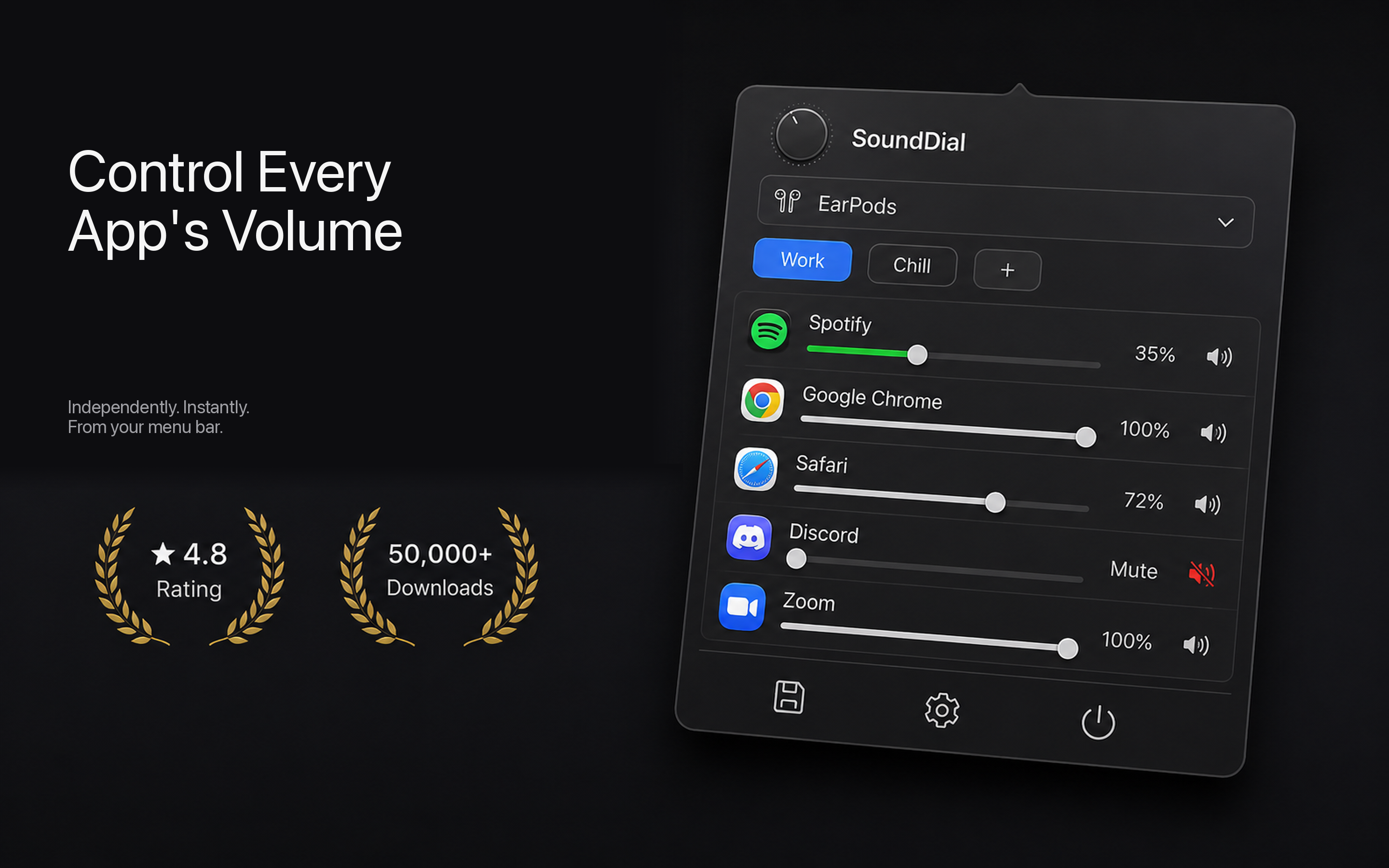
SoundDial is a Mac App Store app, which shapes what it is. Because App Store apps are sandboxed and cannot ship the kind of low-level virtual driver Background Music uses, SoundDial is built to run without installing a separate audio device or DMG. That means:
- No virtual-driver quirks. There is no extra output device hijacking your audio chain, and nothing to reinstall when the system changes.
- It survives macOS updates far more gracefully. App Store distribution and sandboxing mean it is built against supported paths and gets updated through the store, so an OS upgrade is far less likely to leave you silent.
- Per-app volume boost. This is a real feature difference: SoundDial can push an app above 100% for quiet sources — a podcast recorded too low, a muffled video call. Background Music only attenuates.
- Volume profiles. Save a set of per-app levels ("Meeting," "Music," "Gaming") and switch in one click instead of dragging sliders every time.
- Auto-ducking. Automatically drop other apps' volume when a chosen source plays — a more configurable take on the auto-pause idea.
- Quick output switching baked into the menu bar, plus per-app mute.
- Real support. It is a paid product with someone accountable when something goes wrong.
The honest decision
If you want free and only need basic per-app volume, and you are comfortable troubleshooting after macOS updates, Background Music is a solid choice. If you want boost, profiles, ducking, output switching, no virtual-driver fragility, and someone to email when it breaks, SoundDial is worth €14.99.
A few concrete tiebreakers. If you regularly deal with too-quiet sources, boost alone justifies the price — Background Music simply cannot make audio louder than the source. If you dread the annual "will my audio survive the update" gamble, the sandboxed store app removes that anxiety. If you like set-and-forget scenes, profiles save real friction. And it is a one-time €14.99, not a subscription, so the comparison is a single purchase versus your time spent maintaining a free driver.
Conversely, if you are a tinkerer who enjoys open source, wants to read the code, and mostly just turns one app down — save your money. Both tools solve the same core problem; they differ in robustness, feature depth, and who catches you when macOS changes underneath them.
Want per-app volume without the virtual-driver gamble? Get SoundDial on the Mac App Store — a one-time €14.99, sandboxed, no drivers, with boost, profiles, and auto-ducking built in.