FineTune is a free, open-source per-app volume mixer for macOS, so if price is your only concern it's a genuine option. SoundDial is a paid (€14.99, one-time) Mac App Store app that adds per-app volume boost, saved profiles, auto-ducking, and vendor support. The real choice is free-and-DIY versus sandboxed-and-supported.
The problem both apps solve
macOS still has no built-in per-app volume mixer. Windows has had one for years — right-click the speaker icon, open the Volume Mixer, and every app gets its own slider. On a Mac, you get exactly one system volume slider for everything: your music, a video call, YouTube, notification dings, and a game all share it. If your call is too quiet and Spotify is too loud, your only "fix" is muting Spotify entirely.
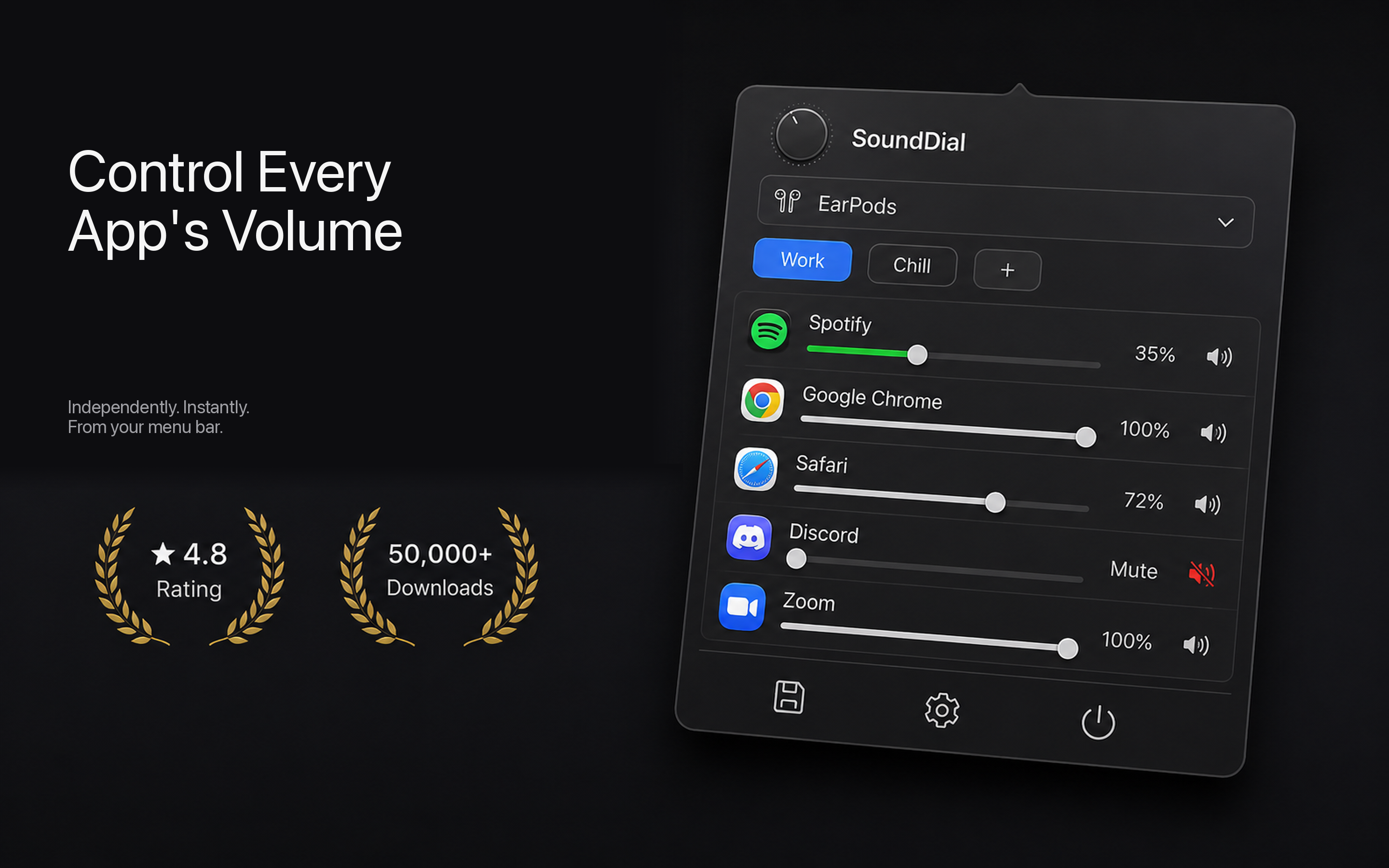
Both FineTune and SoundDial exist to fill that gap. They give each running app its own volume control so you can, say, keep a meeting at 100% while pulling background music down to 20% — without touching the master slider.
What FineTune gets right
FineTune is a newer, free, open-source app in the spirit of SoundSource. Let's be fair about its strengths, because they're real:
- It costs nothing. No license, no trial, no upgrade nag.
- The source is open. You can read exactly what it does, audit it for privacy, and — if you know Swift — modify or fork it.
- It's community-driven. Bugs can be fixed by anyone, and the code outlives any single company.
- It covers the core need. Independent per-app volume, which is the feature 90% of people are actually searching for.
If your only requirement is "let me turn one app down without turning everything down," and you're comfortable with software that comes with no formal support desk, FineTune is a legitimate answer. Recommending it here isn't a concession — it's honest.
The honest trade-offs of the DIY route
Free and open-source carries real costs that don't show up on a price tag. These aren't knocks on FineTune specifically — they're the nature of the approach:
- Installation is manual. Open-source audio tools are typically distributed as a downloaded build or a Homebrew formula, not through the App Store. You install outside Apple's review, and you're on the hook to keep it updated.
- Per-app audio interception is fragile by nature. Routing another app's audio is deep-system work. When Apple ships a macOS update that changes the audio stack, these tools can break until someone patches them. With a volunteer project, "someone" may be busy that month.
- Support is best-effort. If something breaks, your recourse is a GitHub issue and a wait. There's no guaranteed response and no one obligated to fix it.
- Feature scope is whatever the maintainers ship. Core volume control is likely covered; extras depend entirely on contributor time.
The honest framing: FineTune trades money for maintenance responsibility. You save €14.99 and take on the risk that an OS update leaves it broken until the community catches up.
Where SoundDial is different
SoundDial takes the opposite trade. You pay once, and in return you get an App Store product with a vendor behind it and a wider feature set built on top of per-app volume:
- Per-app volume and mute — the shared baseline both apps deliver.
- Per-app volume BOOST — push a too-quiet app past 100%. Useful for apps with weak audio output where turning others down still isn't enough.
- Volume profiles — save whole mixes ("Meeting," "Focus," "Gaming") and switch in one click instead of resetting sliders each time.
- Auto-ducking — automatically lower background apps when you speak or when a chosen app becomes active, so calls cut through without manual fiddling.
- Quick output switching — jump between speakers, headphones, and other outputs from the menu bar.
Just as important is how it ships. SoundDial is sandboxed and distributed through the Mac App Store — no separate DMG, no kernel drivers, no audio driver install. Updates come through the App Store like any other app, and there's a real developer to email when something's wrong. That's the concrete value of the €14.99: not just more features, but someone accountable for keeping them working across macOS releases.
An honest caveat that applies to both
No third-party app can make macOS's audio system into Windows' Volume Mixer, because Apple doesn't expose a clean public API for per-app audio. Every tool in this category — free or paid, open or closed — works around that limitation using system-level audio techniques. That means both FineTune and SoundDial can be affected by major macOS audio changes. The difference is who's responsible for the fix afterward: a volunteer community, or a paid vendor whose product depends on it.
Which should you pick?
- Choose FineTune if you want zero cost, value open-source transparency, only need basic per-app volume, and are comfortable installing outside the App Store and self-supporting when things break.
- Choose SoundDial if you want a one-click App Store install, extras like boost, profiles, and auto-ducking, and the reassurance of updates and support from a vendor with skin in the game.
Both are valid. It genuinely comes down to whether you'd rather spend money or spend attention. If you'd rather buy a supported, sandboxed app and never think about it again, get SoundDial on the Mac App Store for a one-time €14.99 — no subscription, no drivers, no DMG.