If you reached for Boom 3D to boost volume but actually wanted to control each app separately, you want a different tool. Boom 3D is a system-wide volume booster and EQ. SoundDial is a focused per-app volume mixer: independent volume, mute, and boost for each app, one-time €14.99, no EQ, no drivers.
What Boom 3D actually does (and doesn't)
Boom 3D is built around three things: a system-wide volume boost, a 31-band equalizer, and 3D "surround" effects. It applies those to everything your Mac plays at once. That is genuinely useful if your goal is a louder laptop or a bass curve you like across the board.
What Boom 3D is not built for is treating apps as independent channels. There's no clean way to say "Spotify at 40%, my video call at 100%, and this browser tab muted." Its slider moves the whole mix. And because it installs an audio driver to sit in the signal path, it touches your system at a lower level than a sandboxed utility does. It's also positioned as a paid product with upgrade cycles rather than a small one-time tool.
The common story: people install Boom 3D to make one quiet app louder, then realize the real problem was that macOS has no per-app volume mixer at all.
The gap: macOS has no volume mixer
This surprises people coming from Windows. Windows has had a per-app Volume Mixer for years — right-click the speaker, set each app's level individually. macOS simply doesn't ship this. You get one master volume and whatever internal slider each app happens to expose. There is no OS-level way to balance Slack against a YouTube tab against a game.
So when a music app is drowning out your call, your only native options are crude: turn the master down (which quiets everything) or dig through each app's own settings hoping it has a volume control. Boom 3D doesn't close that gap either — it makes the whole mix louder, not each app.
Where SoundDial fits
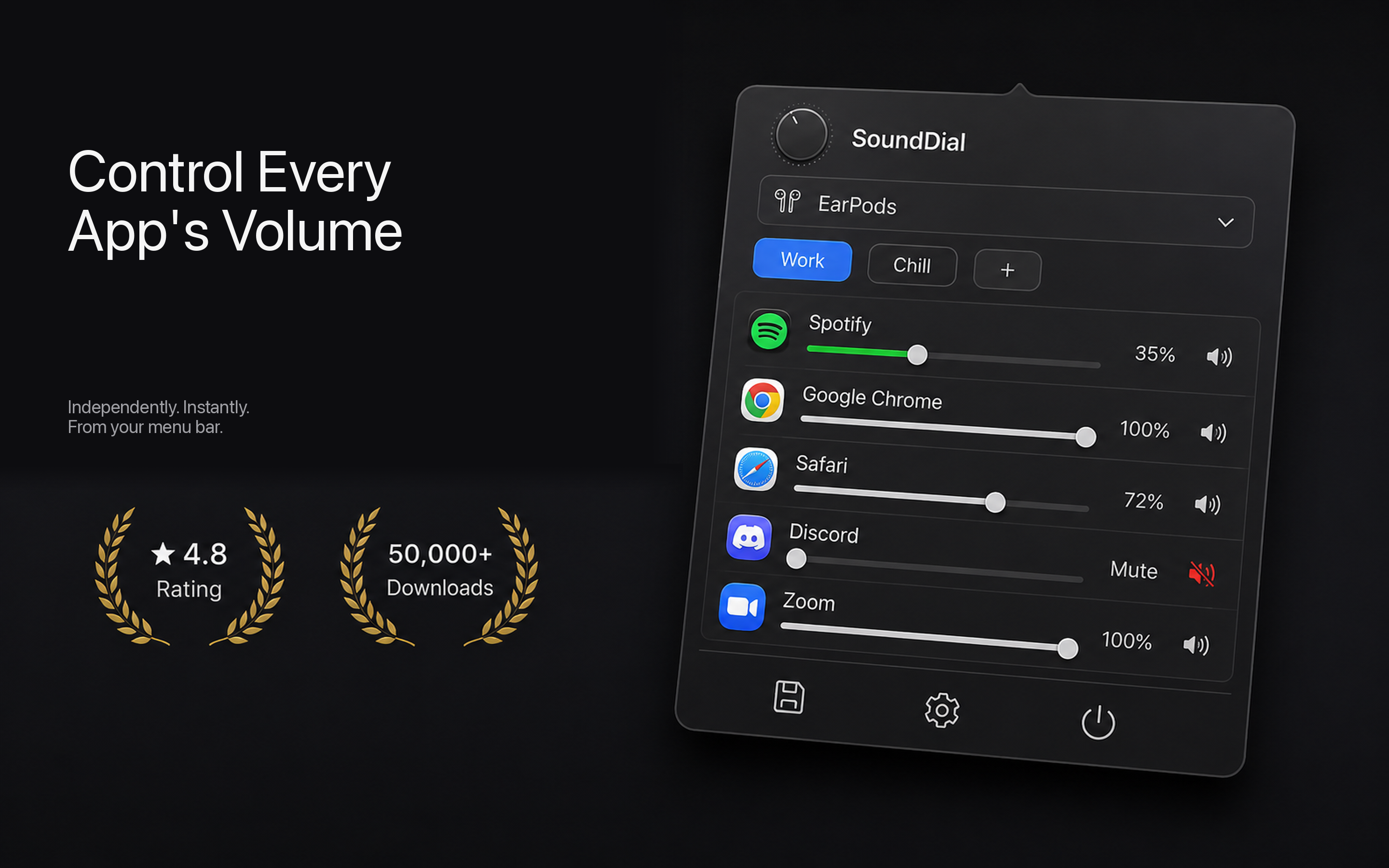
SoundDial is the missing mixer. It lives in your menu bar and gives every running app its own row with its own slider. That's the core difference from Boom 3D: instead of one global effect, you get per-source control.
- Independent volume per app — set Spotify to 30% while your video call stays at 100%.
- Per-app mute — silence one noisy app instantly without touching anything else.
- Per-app boost — if you liked Boom 3D's louder-than-100% trick, SoundDial keeps that, but targeted at a single app instead of the whole system. Quiet apps get pushed past their normal ceiling on their own.
- Volume profiles — save a mixer layout (e.g. "gaming," "meeting," "music") and recall it in one click instead of re-balancing sliders every time.
- Auto-ducking — automatically dip background audio when something important starts, so a call or a game cue isn't buried under music.
- Quick output switching — jump between headphones, speakers, and other outputs from the same menu.
What SoundDial deliberately doesn't do is the rest of the Boom 3D feature sprawl. There's no 31-band EQ, no faux-surround processing, no system-wide effect chain. If you want a mastering-grade EQ, Boom 3D or a dedicated audio suite is the right pick. If what you actually kept opening Boom 3D for was volume, that surface area is bloat you're paying to carry.
Boost, without the driver
The "boost" question deserves a direct answer, because it's usually why Boom 3D users shop for alternatives. Boom 3D's boost is global and driver-based. SoundDial's boost is per-app and runs inside Apple's app-sandbox model — it's distributed through the Mac App Store, so there's no separate installer, no kernel-level driver, and no leftover system components to uninstall later. You get the "make this one quiet app louder" outcome without handing a driver control of your entire audio path.
Price: one-time vs. ongoing
Boom 3D is a paid app with its own upgrade and licensing model, and pricing varies by platform and version. SoundDial is a single one-time purchase at €14.99 — buy it once, keep it, no subscription and no per-version repurchase to keep the mixer working. For a utility you'll leave running in the menu bar every day, a flat price tends to age better than a product you have to keep re-buying into.
Which one should you pick?
- Choose Boom 3D if your real need is a serious equalizer and system-wide audio effects, and you don't mind an audio driver in the mix.
- Choose SoundDial if you want what Windows users take for granted — a real per-app volume mixer — plus targeted boost, profiles, and auto-ducking, at a one-time price and with no drivers to install.
Most people who bounce off Boom 3D fall into the second group. They didn't want to tune frequencies; they wanted the browser quieter than the call. That's exactly the job SoundDial is built for.
Want per-app volume control on your Mac without the EQ bloat or a subscription? Get SoundDial on the Mac App Store — €14.99 once, sandboxed, no drivers, and every app gets its own slider.