Sound Control by Static Z Software is discontinued and no longer sold or updated, and it increasingly fails on modern macOS because it relied on a kernel-level audio driver that Apple has locked down. If you need per-app volume today, the cleanest replacement is SoundDial, a sandboxed Mac App Store mixer with no drivers.
What Sound Control actually did
Sound Control was, for years, the go-to answer to a genuine macOS gap: there is still no built-in per-app volume mixer on the Mac. Windows has had one in its Volume Mixer since Vista, but macOS only gives you a single master slider. Sound Control filled that hole with a tidy menu-bar panel that let you:
- Set an independent volume level for each running app.
- Mute individual apps without touching the rest of your system audio.
- Boost quiet apps above 100 percent.
- Apply per-app equalizer and balance adjustments.
- Route audio and pin apps to specific output devices.
For anyone who has ever had a Zoom call blasting while a background YouTube tab whispers, that per-app control was transformative. It became a quiet staple on a lot of Mac power users' machines.
Why it stopped working
The honest technical story matters here, because it explains why this is not a bug someone can simply patch. Sound Control worked by installing a system audio driver — a kernel extension (kext) that inserted itself into the macOS audio pipeline so it could intercept and reshape each app's output. That deep hook is exactly what made the EQ and boost features possible.
Starting with macOS 10.15 Catalina and accelerating through Big Sur and the Apple Silicon transition, Apple began deprecating kernel extensions in favor of user-space alternatives. On Apple Silicon Macs, loading third-party kexts requires lowering system security in Recovery Mode, and Apple has made it clear that legacy audio kexts are on borrowed time. Static Z Software ultimately stopped selling and developing Sound Control. The result: on recent macOS versions, installs fail, audio glitches out, or the driver simply refuses to load without security downgrades most people rightly do not want to make.
This is not neglect on the developer's part. It is a platform-level shift. Apple closed the door on the kind of low-level audio driver Sound Control was built around, and no update can fully reopen it.
What changed on modern macOS
Apple did add one relevant thing: Core Audio now offers a Tap API (introduced in macOS 14.2 Sonoma) that lets apps capture and process per-process audio from user space — no kext, no security downgrade, no reboot into Recovery. This is the sanctioned modern path for per-app audio, and it is what a current mixer should be built on. The tradeoff is honest: user-space taps are more constrained than an old kernel driver, so you should expect clean per-app volume, mute, and boost rather than the full per-app parametric EQ Sound Control offered.
The best replacement: SoundDial
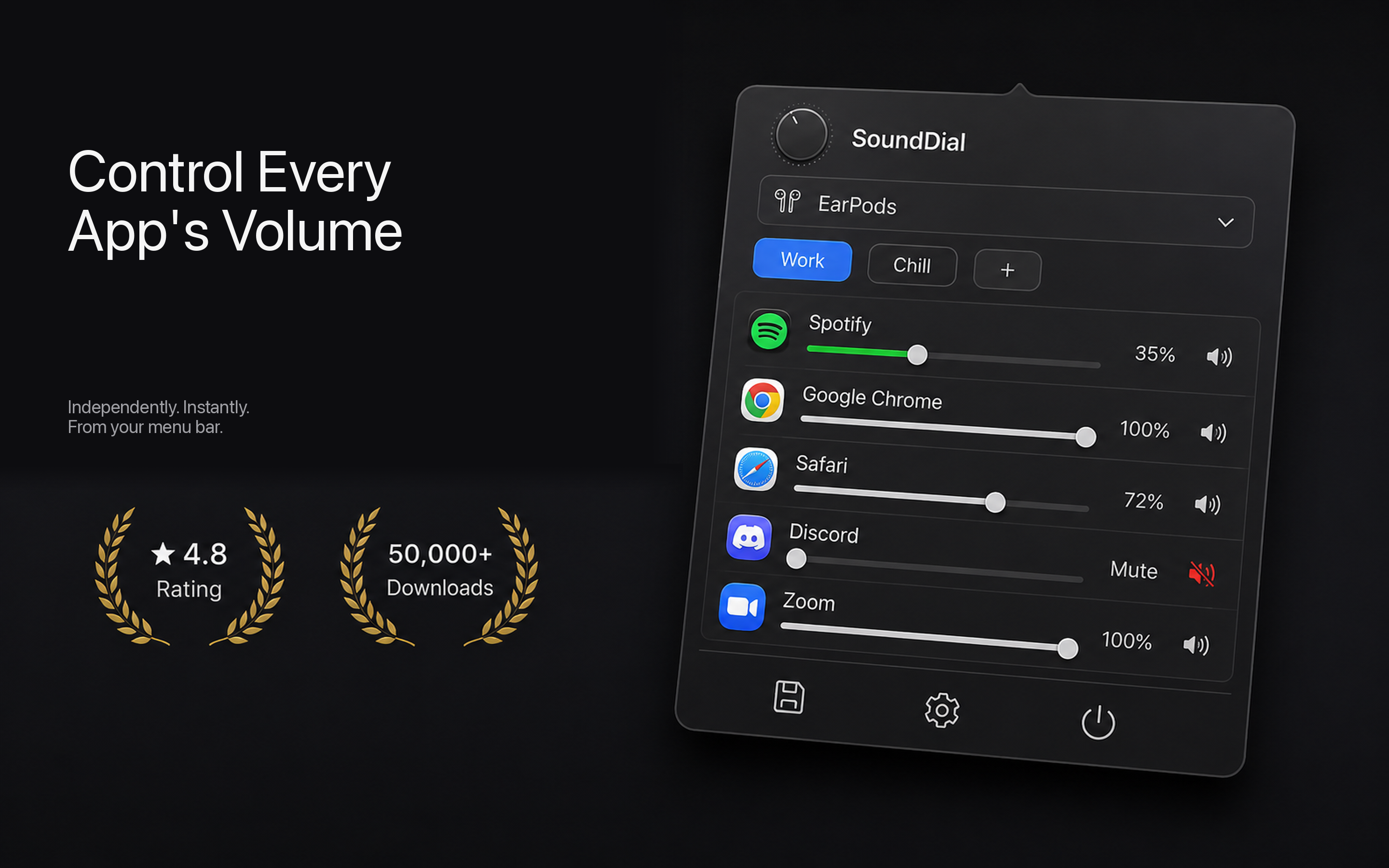
If you want the core of what Sound Control did — independent volume per app — on a Mac you can actually keep secure and up to date, SoundDial is the closest clean-migration option in 2026. It is a menu-bar per-app volume mixer built for the modern macOS audio stack. What carries over from the Sound Control workflow:
- Independent volume per app — one slider per running application, right in the menu bar.
- Per-app mute — silence one app while everything else keeps playing.
- Per-app volume boost — push a quiet app above its normal ceiling.
- Volume profiles — save mixer setups for different contexts (calls, music, gaming) and switch between them.
- Auto-ducking — automatically lower background app volume, useful when you start talking or a call comes in.
- Quick output switching — jump between speakers, headphones, and other devices without diving into System Settings.
The practical differences that matter for a migration: SoundDial ships through the Mac App Store, is sandboxed, and installs no drivers and no DMG. That means no kernel extension to approve, no Recovery Mode, and no lowering your Mac's security posture — the exact pain points that killed Sound Control. It is a one-time purchase of €14.99, not a subscription.
How to switch, step by step
- Uninstall Sound Control cleanly. Because it installed a driver, use its own uninstaller if it still runs, or remove its audio driver components before installing anything new. Two competing audio hooks can cause glitches.
- Install SoundDial from the App Store. No reboot or security changes required.
- Grant the audio permission it requests. This is what lets it read and control per-app output on modern macOS.
- Open the menu-bar panel and set levels. Your running apps appear with individual sliders; adjust, mute, or boost as needed.
- Save a profile. If you had favorite Sound Control setups, recreate them as profiles so you can switch in one click.
Honest expectations
If your only reason for using Sound Control was per-app volume, mute, and boost, a modern sandboxed mixer covers you fully. If you leaned heavily on its per-app equalizer, be aware that deep EQ was tied to the old driver model and is the hardest feature to reproduce cleanly under Apple's current rules. Set expectations accordingly, and you will not be surprised.
Ready to get per-app volume back without the driver headaches? Get SoundDial on the Mac App Store — a one-time €14.99, sandboxed, no subscription, no drivers.