If SoundBunny stopped working or is no longer sold, the modern replacement is SoundDial, a menu-bar per-app volume mixer built for current macOS. It gives you the same core job — independent volume, mute, and boost per application — as a €14.99 one-time Mac App Store purchase, with no kernel driver, DMG, or subscription to manage.
What happened to SoundBunny?
SoundBunny was Prosoft Engineering's per-app volume utility for macOS. It let you set a different volume level for each running app right from the menu bar — Music quiet, a call loud, a browser somewhere in between. For years it was one of the few tools filling a gap Apple never closed.
The problem is that SoundBunny is legacy software. It hasn't kept pace with the deep changes Apple made to macOS audio and security — Apple Silicon, the hardened runtime, tightened system-extension rules, and the removal of older audio hooks. When a utility like this stops receiving updates, it eventually breaks: it fails to launch, loses control of app streams after an OS update, or simply can't be installed cleanly on a modern Mac. If that's where you are, you're not doing anything wrong. The app is behind, not you.
Why macOS still needs a third-party mixer at all
Here's the honest part: this is a genuine gap in macOS, not a bug you can fix in Settings. Windows has shipped a per-app Volume Mixer for well over a decade. macOS has never had one. The system volume slider and Sound settings control your output device as a whole — every app rides the same master level. There is no built-in way to say "keep Safari at 40% but Zoom at 100%."
That's why tools like SoundBunny existed, and why a replacement is still necessary today. The need didn't go away when the app did — Apple just still hasn't addressed it.
The modern replacement: SoundDial
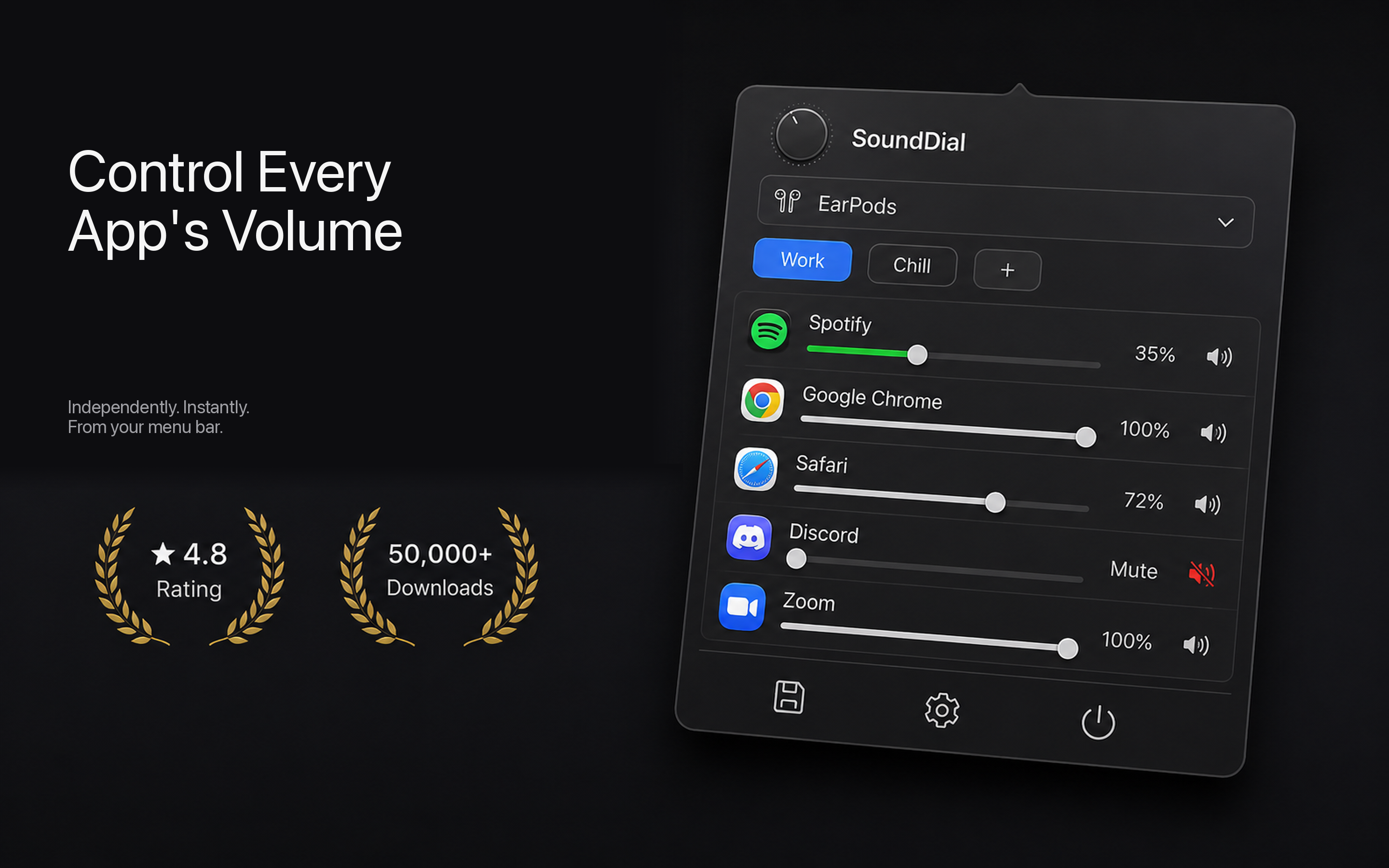
SoundDial is a per-app volume mixer that lives in your menu bar and does the things SoundBunny users relied on, built against today's macOS instead of yesterday's. The feature overlap covers the essentials:
- Independent volume per app — one slider per running application, exactly the SoundBunny mental model.
- Per-app mute — silence a single noisy app without touching everything else.
- Per-app volume boost — push a quiet app above 100% when a video or call is recorded too low. SoundBunny couldn't reliably amplify past system max on modern macOS; boost is a real upgrade here.
- Volume profiles — save a set of per-app levels (a "work" mix, a "gaming" mix) and switch between them instead of nudging sliders one at a time.
- Auto-ducking — automatically lower background app volume when another audio source (like your mic on a call) becomes active.
- Quick output switching — jump between speakers, headphones, and other outputs from the same menu.
What migrating actually looks like
There's no import step — per-app volume levels aren't a file you carry over — but the switch is quick:
- Remove SoundBunny properly. Quit it, then delete the app. If it installed any helper or login item, remove that too so two utilities aren't fighting over the same audio streams.
- Install SoundDial from the Mac App Store. It's sandboxed and distributed through the store, so there's no DMG to mount and no "unidentified developer" warning. One purchase, tied to your Apple ID.
- Grant audio access on first launch. macOS will ask permission for SoundDial to see app audio. This is the modern, sanctioned path Apple provides — no kernel extension, no reboot, no lowering system security. Grant it and your running apps appear as sliders.
- Rebuild your mix. Set your common apps, then save that arrangement as a profile so you never have to redo it.
The practical differences from SoundBunny
The most important difference is that SoundDial is current software. It runs natively on Apple Silicon, uses Apple's supported audio APIs, and is a Mac App Store app — which means updates arrive through the store and it's built to survive OS upgrades rather than break on them. Being sandboxed also means it can't reach outside its lane, which is reassuring for something that sits between your apps and your speakers.
A couple of honest caveats so expectations are right. Because SoundDial works within Apple's audio framework, control is best for standard apps that route through the normal system output. Some software plays audio through its own path or an exclusive device, and no menu-bar mixer — SoundBunny included — can fully govern those. And per-app volume is inherently a software layer on top of macOS; it's not a hardware mixer. Within those real limits, it does the job SoundBunny used to do.
If you switched to a Mac from Windows expecting a per-app Volume Mixer, this is the tool that fills that gap — and now it's one that's actually being maintained.
SoundBunny had a good run, but it's legacy. If you need per-app volume, mute, and boost on a modern Mac, get SoundDial on the Mac App Store — €14.99 once, no subscription, no drivers.