If your USB DAC's volume slider is greyed out on Mac, it's usually not a bug. macOS disables its software volume when a DAC reports that it has no controllable volume, expecting you to use the DAC's own hardware knob. To get software volume back, use an app-level attenuator like SoundDial.
Why macOS greys out the volume for some USB DACs
When you plug in a USB audio device, macOS asks it what it can do over the USB Audio Class (UAC) protocol. Part of that handshake is a set of "feature unit" controls, including a volume control. If the DAC declares a volume control, macOS wires it to your keyboard volume keys and the menu-bar slider. If the DAC declares that it has no host-adjustable volume, macOS greys the slider out completely.
Many high-quality DACs and amps do exactly the latter, on purpose. The designer's assumption is that you'll feed the DAC a full-scale, bit-perfect digital signal and control loudness with the analog volume knob on the unit itself. That analog attenuation happens after the digital-to-analog conversion, so it avoids throwing away bits and is genuinely the audiophile-preferred path. It's a feature, not a fault.
Rule of thumb: if your DAC has a physical volume knob and the Mac slider is greyed out, the manufacturer wants you to use the knob. The signal is being sent at 100% by design.
When the greyed-out slider is actually a problem
The "just use the knob" answer breaks down in real setups:
- The DAC has no knob. Plenty of compact USB DACs, dongles, and pro interfaces expose no volume control and no host control either. You're stuck at whatever level the downstream amp or powered speakers are set to.
- The knob is out of reach. A desktop DAC behind your monitor, or a unit feeding a fixed-gain amp, means adjusting volume becomes a physical chore instead of a keypress.
- You need per-app balance, not just a master level. Even a perfect hardware knob is a single global control. It can't make a Zoom call quieter than your music, or duck a game when a notification fires.
None of these are fixed by macOS, because from the OS's perspective the device is behaving correctly. This is the honest limitation: it's a device-reported capability, and there is no toggle in System Settings to override it.
Honest workarounds before you install anything
Try these first, because they cost nothing:
- Use the hardware knob or downstream volume. If your DAC or your powered speakers/amp have a control, that's the cleanest option and preserves full digital resolution.
- Check the DAC's own app or firmware. Some DACs (and gaming-oriented units) ship a control panel or a firmware setting that enables host volume. If a "USB volume" or "software volume" option exists, turning it on makes the macOS slider work again.
- Try a different USB mode. A few devices report different capabilities in "class-compliant" vs. a proprietary driver mode. Installing or removing the vendor driver can change whether macOS sees a volume control.
- Look in Audio MIDI Setup. Open Audio MIDI Setup, select the device, and check whether a master or per-channel volume appears there. Occasionally a slider is available in that panel even when the menu bar one is greyed out.
If none of those apply, you need software attenuation on the Mac side.
Software volume control with per-app attenuation
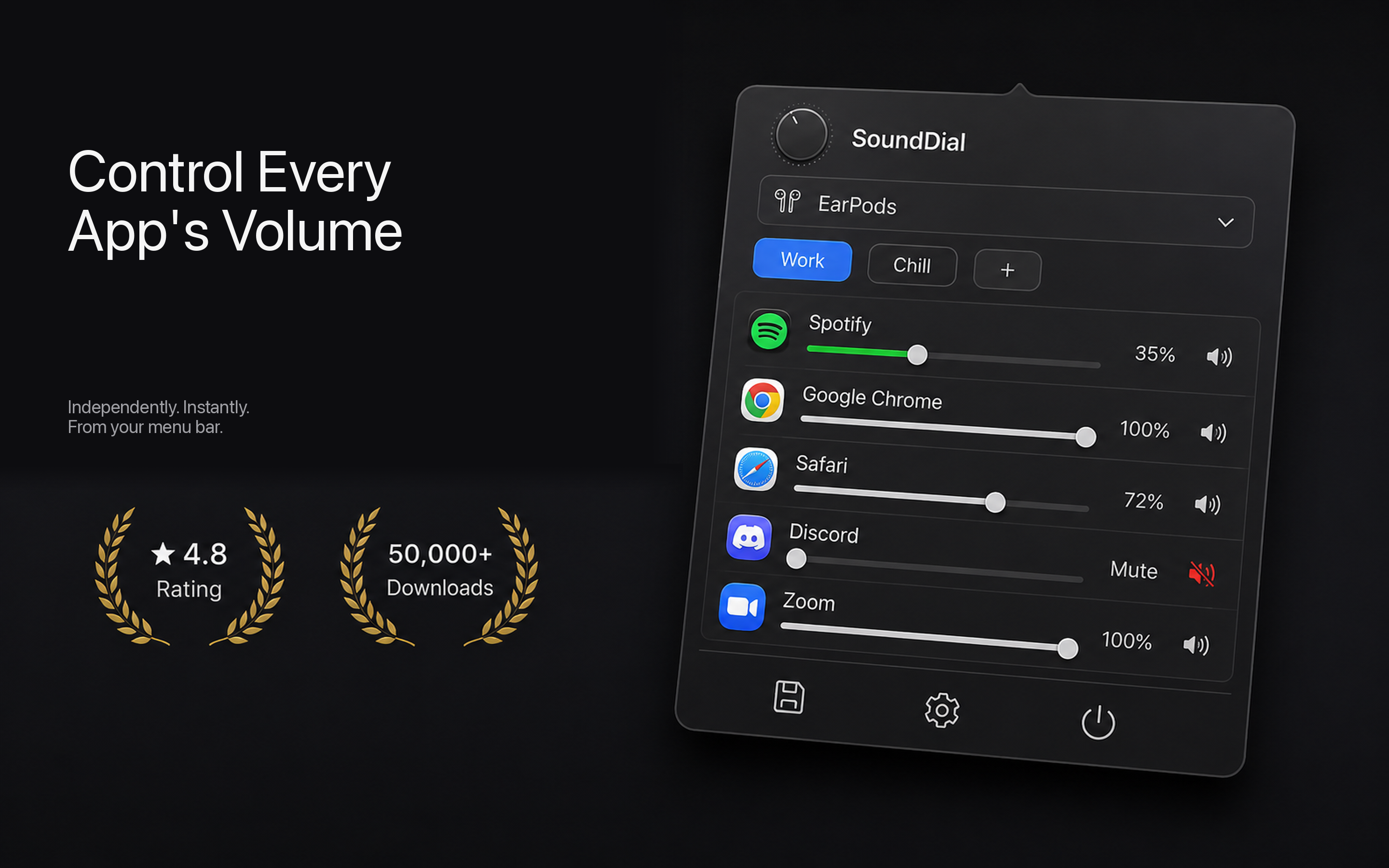
When the hardware won't accept a volume command, the remaining option is to attenuate the audio in software before it reaches the DAC. This is exactly what SoundDial does. It sits in your menu bar and gives every running app its own independent volume, mute, and even a boost, regardless of whether your DAC exposes a hardware control.
To use it for a greyed-out DAC:
- Install SoundDial from the Mac App Store and open it from the menu bar.
- Keep your DAC selected as the system output; you can also use SoundDial's quick output switching to move between the DAC, speakers, and headphones without diving into System Settings.
- Set per-app levels: drop the browser, raise the music player, mute whatever you don't want. Each app streams at the volume you choose, and the mixed result goes to the DAC.
- Save volume profiles for different scenarios (calls vs. listening), and let auto-ducking lower background apps when something more important starts playing.
The honest tradeoff on audio quality
Software attenuation reduces the digital level before conversion, so in theory it discards a small amount of resolution compared with analog volume on the DAC itself. In practice, on modern 24-bit and higher paths at normal listening levels, the reduction is well below anything audible, and you keep the DAC's full dynamic range for anything played near full scale. If you're a purist with a good analog knob within reach, use the knob. If you have no usable hardware control, or you need per-app balance macOS simply can't provide, software volume is the right tradeoff, and it beats a slider that does nothing.
SoundDial is a €14.99 one-time purchase, sandboxed, with no drivers, kernel extensions, or DMG installers. If your USB DAC's volume is greyed out and reaching for a knob isn't an option, get SoundDial on the Mac App Store and put working volume control back in your menu bar.