macOS has no built-in per-app volume mixer like the one in Windows, so the fastest reliable fix is SoundDial, a Mac App Store menu-bar app that gives every app its own volume slider, per-app mute, and volume boost. It's sandboxed, Apple-reviewed, installs with no drivers, and costs €14.99 once.
Why Windows can do this and macOS can't
If you've used Windows, you know the drill: right-click the speaker icon, open Volume Mixer, and drag a separate slider for Chrome, Spotify, Discord, and anything else making noise. It's simple and it just works.
macOS never shipped an equivalent. Apple's audio controls are global — one master volume for the whole system. You can mute an app by muting the source inside that app (if it even has a control), but there's no unified place to say "keep my music at 40% while my meeting stays at 100%." That gap is exactly why third-party mixers exist.
The fastest fix: a menu-bar mixer
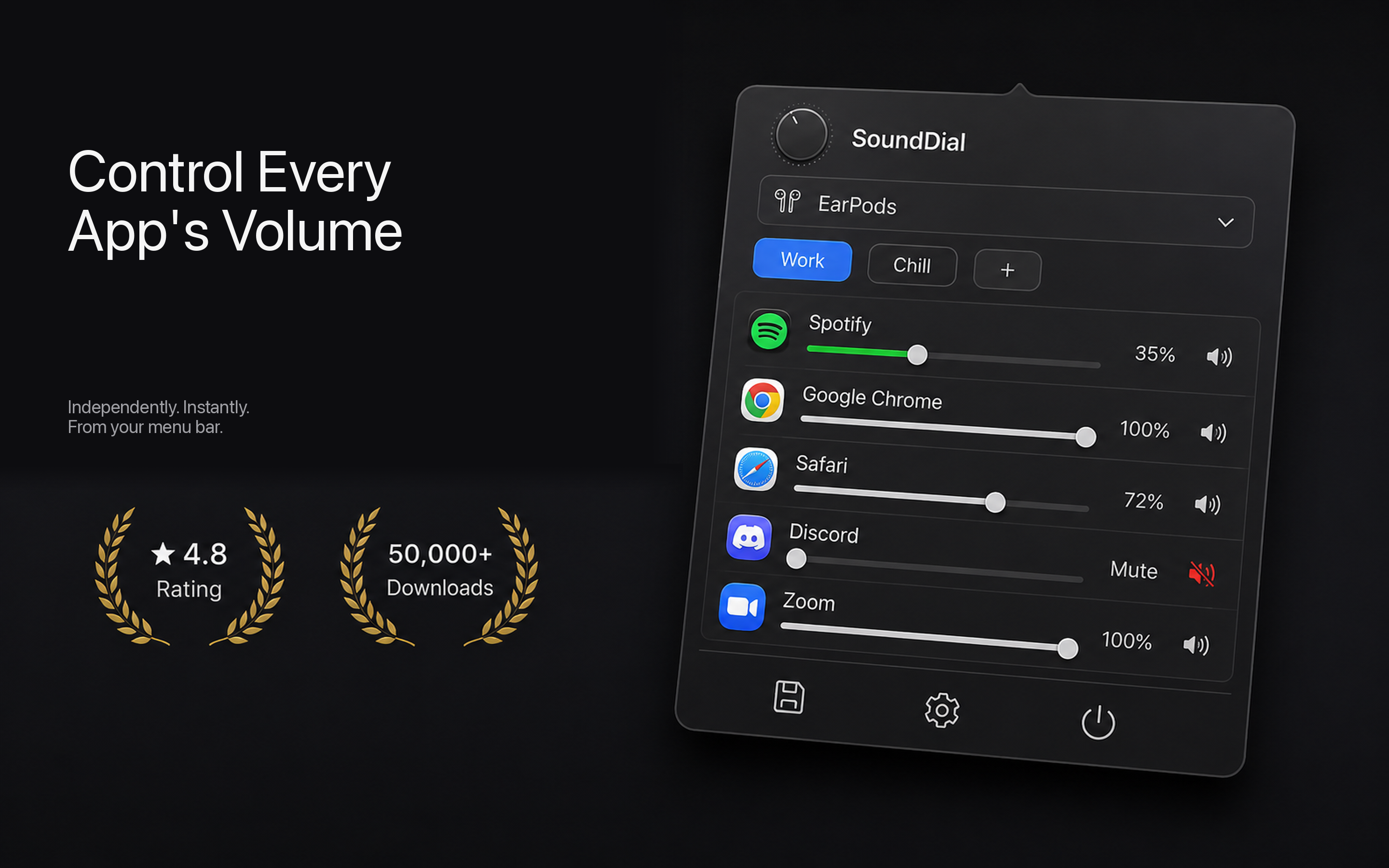
The closest match to the Windows experience is a menu-bar app that lists your running audio apps and gives each one a slider. SoundDial does precisely this. Click its icon in the menu bar and you get:
- Independent volume for every app — drag Spotify down without touching your call.
- Per-app mute — silence one noisy app instantly, leave the rest playing.
- Per-app volume boost — push a too-quiet app above 100% when its own max is still too soft.
- Volume profiles — save a "Work" or "Gaming" mix and recall it in one click.
- Auto-ducking — automatically lower background audio when something more important starts.
- Quick output switching — jump between speakers, headphones, and other outputs from the same menu.
Because it's on the Mac App Store, it's sandboxed and reviewed by Apple, it installs cleanly, and there's no DMG to drag, no kernel extension, and no audio driver to approve in System Settings. That last part matters more than it sounds — driver-based tools are the ones that tend to break after macOS updates.
How to set it up (about two minutes)
- 1. Install SoundDial from the Mac App Store and launch it.
- 2. Grant the audio permission macOS prompts for — this is what lets the app see per-app streams.
- 3. Click the SoundDial icon in your menu bar. Every app currently playing audio shows up with its own slider.
- 4. Drag any app's slider to set its level, or hit mute. Boost past 100% when an app is too quiet.
- 5. (Optional) Save your current mix as a profile so you can restore it later, and turn on auto-ducking if you want background audio to drop automatically.
That's the whole workflow. It behaves like the Windows Volume Mixer you already know, minus the setup friction.
What about the free and pro alternatives?
There are other ways to get per-app volume on a Mac. They're worth knowing so you can choose honestly.
Free tools trade money for reliability and features; pro tools trade money and setup for depth you may not need.
Background Music is free and open-source, and it does provide per-app volume. The catch: it hooks deep into the audio system and has a history of breaking on newer macOS releases, and it lacks boost, profiles, and auto-ducking. If it works on your setup, great — but it's a gamble across upgrades.
FineTune is a free, open-source menu-bar app in the same spirit as SoundDial. It's a fine starting point if budget is the only concern, though it's a community project without the profiles and ducking polish.
eqMac is a free system-wide EQ and booster. It's great for shaping overall sound, but it isn't a true per-app mixer — you're adjusting the whole output, not individual apps.
SoundSource by Rogue Amoeba (around $39) is the pro-grade option: per-app EQ, output routing per app, and serious audio-engineer features. It's excellent — but it needs a direct download and installs an audio capture component, and it costs more than double what SoundDial does. If you want studio-level routing and EQ, it's the pick. If you just want the Windows-style mixer, it's overkill.
Which one should you get?
If your goal is "make my Mac work like the Windows Volume Mixer" without downloads, drivers, or risk, SoundDial is the cleanest answer. You get per-app volume, mute, boost, profiles, and auto-ducking, all App Store-safe, for a one-time €14.99 — no subscription. Choose SoundSource instead only if you specifically need per-app EQ and output routing, and try the free options if you're comfortable troubleshooting them across macOS updates.
Ready to give every app its own volume? Get SoundDial on the Mac App Store and set up your first mix in about two minutes.