If all you want is independent volume per app on macOS, Audio Hijack is more tool than you need. It's a pro audio-routing and recording suite (around $79) built for capture, effects, and session graphs. For simply turning one app down and another up, a lightweight menu-bar mixer like SoundDial is faster, cheaper, and always ready.
Why people reach for Audio Hijack in the first place
macOS has no built-in per-app volume mixer. Windows has had one for years in its Volume Mixer, but on a Mac the volume keys and the menu-bar slider only move one thing: the system master. There's no first-party way to say "keep Spotify at 40% but leave my video call at 100%."
So people search for a workaround and land on Audio Hijack. It can do per-app volume, because it can intercept and process the audio from any single application. But that capability is a side effect of what it's actually designed for: recording audio from apps and hardware, chaining effects, routing between virtual devices, and building reusable session pipelines. It's genuinely excellent at that. It's just a heavy answer to a light question.
Where Audio Hijack becomes overkill
A few things tend to frustrate people who only wanted a volume slider:
- Price. Audio Hijack sits around $79. That's fair for a recording studio in an app; it's a lot for turning down a browser tab.
- It has to keep running. Its per-app processing only works while the app is open and the relevant session is active. Quit it, and your volumes revert. You're keeping a full audio workstation resident just to hold a slider in place.
- Session-based thinking. You build sessions with blocks and connections. Powerful for capture, but it's a lot of conceptual overhead when your goal is "this app quieter, that app louder."
- The interface is deep. Effects, routing, meters, block wiring — a rich surface area you'll mostly ignore if you never record anything.
Rule of thumb: if you want to record or route audio, Audio Hijack earns its price. If you only want to balance audio between apps, you're paying for a workshop when you needed a knob.
The simpler alternative: a menu-bar volume mixer
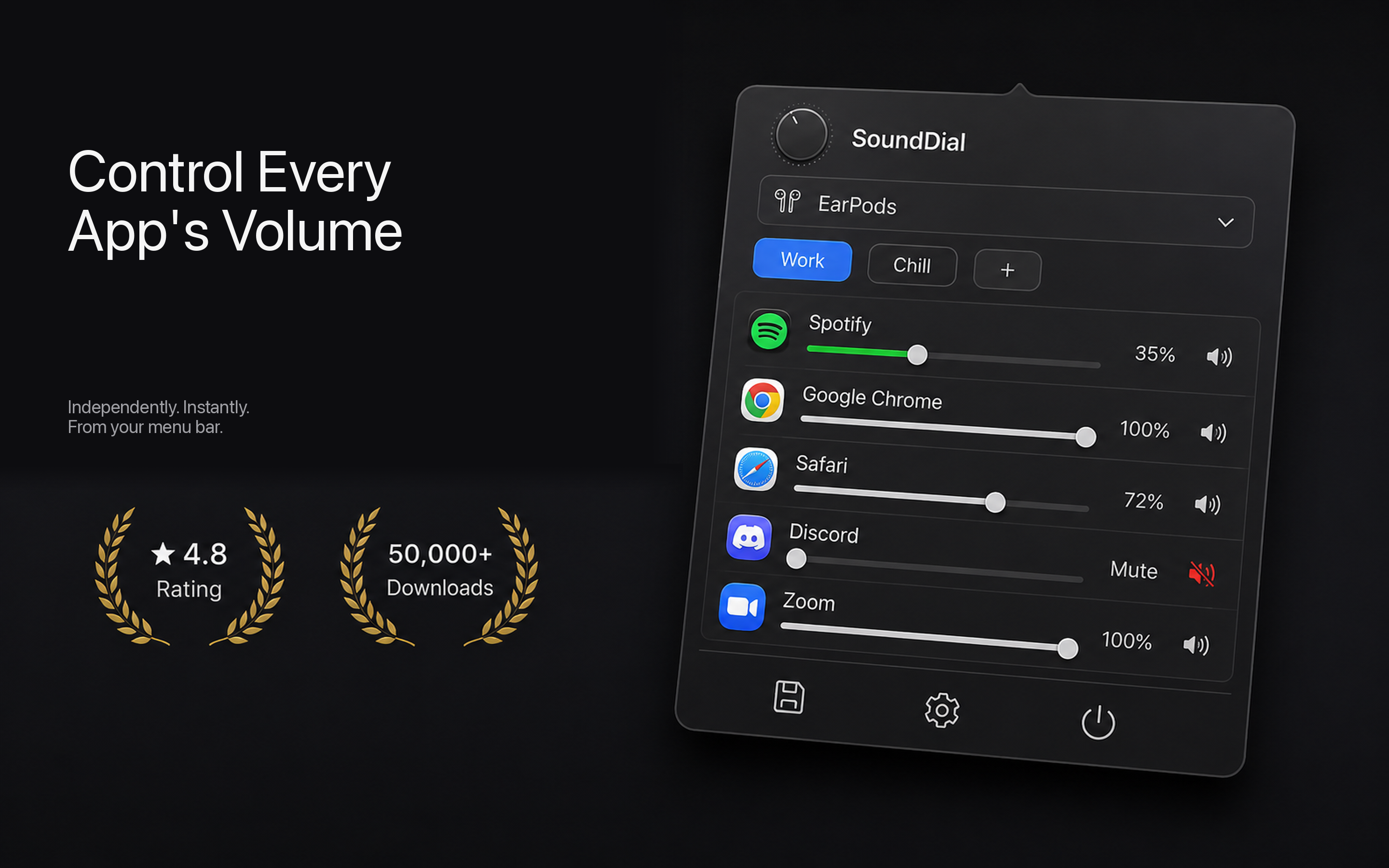
SoundDial takes the one job most people actually came for and does only that. It lives in your menu bar. Click the icon and you get a live list of every app currently playing audio, each with its own slider. Drag Spotify to 30%, leave your call at 100%, mute Slack entirely — done, no session to build.
What it covers:
- Independent volume per app — every audio source gets its own slider, adjustable in real time.
- Per-app mute — silence one noisy app with a click without touching anything else.
- Per-app volume boost — push a quiet app above 100% when its own max is still too soft. This is the piece the system slider can never do.
- Volume profiles — save a whole mix (music low, calls loud, notifications muted) and recall it in one click for a given context.
- Auto-ducking — automatically dip background audio when something more important starts, so a call or a video isn't buried under your playlist.
- Quick output switching — jump between headphones, speakers, and other outputs from the same menu.
Practical: getting per-app control in under a minute
The setup difference is the whole point. With a routing tool you'd create a session, add a source block, wire it, and keep the app running. Here it's essentially:
- Install SoundDial from the Mac App Store.
- Play audio in a couple of apps so they appear in the list.
- Click the menu-bar icon and drag each app's slider to taste.
- Optionally save that mix as a profile, or boost a too-quiet app past 100%.
Because it's distributed through the Mac App Store, it's sandboxed and installs like any normal app — no .dmg to drag, no kernel extension, no audio driver to approve in Security settings, and nothing that needs re-approving after a macOS update. That last point matters: driver-based mixers historically break on OS upgrades and require reinstalling a system-level component. A sandboxed App Store app avoids that entire category of maintenance.
Which one should you pick?
Be honest about the job. Choose Audio Hijack if you need to record app or hardware audio, apply real-time effects, or build routing graphs between virtual devices. That's its home turf and it's worth every dollar there.
Choose a dedicated menu-bar mixer if your actual need is "let me set the volume of each app independently." You'll spend €14.99 once instead of ~$79, skip the session-building, and get boost, mute, profiles, and ducking in a panel you open from the menu bar. No recording features you'll never touch, no workstation running in the background to hold a slider in place.
Most people who tried Audio Hijack for volume balancing were solving a small problem with a big tool. If that's you, the small tool fits better — and costs a fraction as much.
Get SoundDial on the Mac App Store for €14.99, one-time — per-app volume, boost, mute, profiles, and auto-ducking, right from your menu bar.