macOS has no built-in Volume Mixer like Windows, so you can't set per-app volume from System Settings. The fastest, reliable fix is SoundDial, a €14.99 menu-bar app from the Mac App Store. It gives every app its own volume slider, mute, and boost — no drivers, no DMG, no risky installs.
Why the Windows Volume Mixer has no Mac equivalent
If you switched from Windows, one of the first things you'll miss is the Volume Mixer: right-click the speaker icon, and every running app gets its own slider. Turn Chrome down, keep Discord loud, mute Spotify — all in one place.
macOS simply doesn't ship this. Apple's volume control is a single system-wide slider. Whatever level you set applies to everything at once. There's no per-app option hidden in System Settings, no Terminal command, no accessibility toggle. It's a genuine gap, and it's been that way for years.
The reason is architectural: apps route audio through Core Audio to your output device, and the OS doesn't expose a user-facing mixer for the individual streams. To recreate the Windows experience, you need a third-party app that sits in that audio path and gives you the controls Apple left out.
The closest match: SoundDial
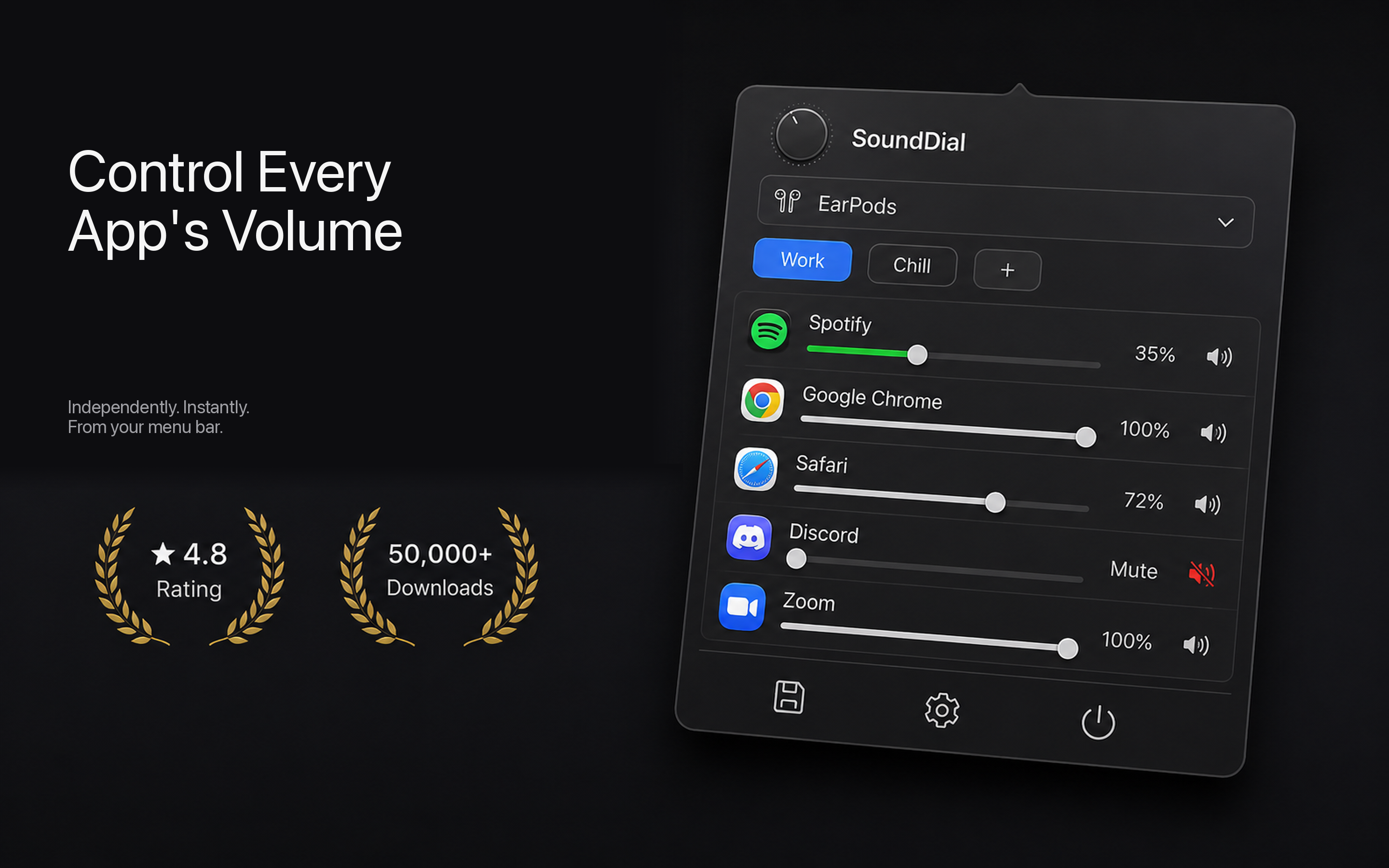
SoundDial is a menu-bar per-app volume mixer built specifically for this. Click its icon and you get a clean list of everything playing audio, each with its own slider. It's the most direct "Windows Volume Mixer for Mac" you can install, and it does a few things the Windows mixer never could:
- Independent volume per app — the core feature. Set Chrome to 40%, Zoom to 100%, music to 20%.
- Per-app mute — silence one app without touching the rest.
- Per-app volume boost — push a quiet app above 100% when its own audio is too low.
- Volume profiles — save a mix (e.g. "work call" or "gaming") and recall it instantly instead of re-dragging sliders.
- Auto-ducking — automatically lower background audio when something more important starts, like a call.
- Quick output switching — jump between speakers, headphones, and other devices from the same menu.
Because it's on the Mac App Store, it's Apple-reviewed and sandboxed. It installs cleanly with one click — no DMG to drag, no audio driver or system extension to approve, no security prompts. At €14.99 one-time (no subscription), it's the simplest way to close the gap.
How to set up per-app volume on your Mac
- Install SoundDial from the Mac App Store.
- Grant the one-time audio permission it requests on first launch.
- Click the SoundDial icon in your menu bar.
- Drag the slider next to any app to set its volume, or hit mute/boost.
- Optionally, save the current mix as a profile so you can restore it later.
That's the whole workflow. It behaves like the Windows mixer you already know, just from the menu bar instead of a right-click on the taskbar.
How SoundDial compares to other options
SoundDial isn't the only tool in this space, so here's an honest look at the alternatives.
- SoundSource (Rogue Amoeba) — around $39, and genuinely pro-grade: per-app EQ, output routing per app, effects. But it requires a direct download plus an audio capture driver, and it's overkill (and pricier) if you just want per-app volume. Choose it if you need EQ and routing; choose SoundDial if you want the mixer without the complexity or the driver.
- Background Music — free and open-source, which is great. The catch: it can break on newer macOS versions, and it lacks boost, saved profiles, and auto-ducking. Fine if you're comfortable troubleshooting open-source audio drivers; less ideal if you want something that just works.
- FineTune — a free open-source menu-bar app. Lightweight and worth a look if budget is the priority, but you're trading polish, profiles, and App Store safety for free.
- eqMac — a free EQ and system-wide booster. It's an equalizer first, not a per-app mixer, so it solves a different problem.
The trade-off is simple. Free tools cost nothing but can be fragile or feature-thin. SoundSource is powerful but expensive and driver-based. SoundDial sits in the sweet spot: a one-time €14.99, App Store safety and sandboxing, and the profiles + auto-ducking that the free options skip.
If all you want is the Windows Volume Mixer experience — per-app sliders, mute, and boost, installed safely in seconds — SoundDial is the most direct match.
The bottom line
macOS won't give you a Volume Mixer, and it probably never will. But you don't have to live with one system-wide slider. A dedicated menu-bar mixer restores the per-app control you had on Windows, and adds boost, profiles, and auto-ducking on top.
Ready to get per-app volume the easy way? Get SoundDial on the Mac App Store for €14.99 — one-time, sandboxed, and installs in seconds.